Church Entrance Sign Design That Reads Clearly
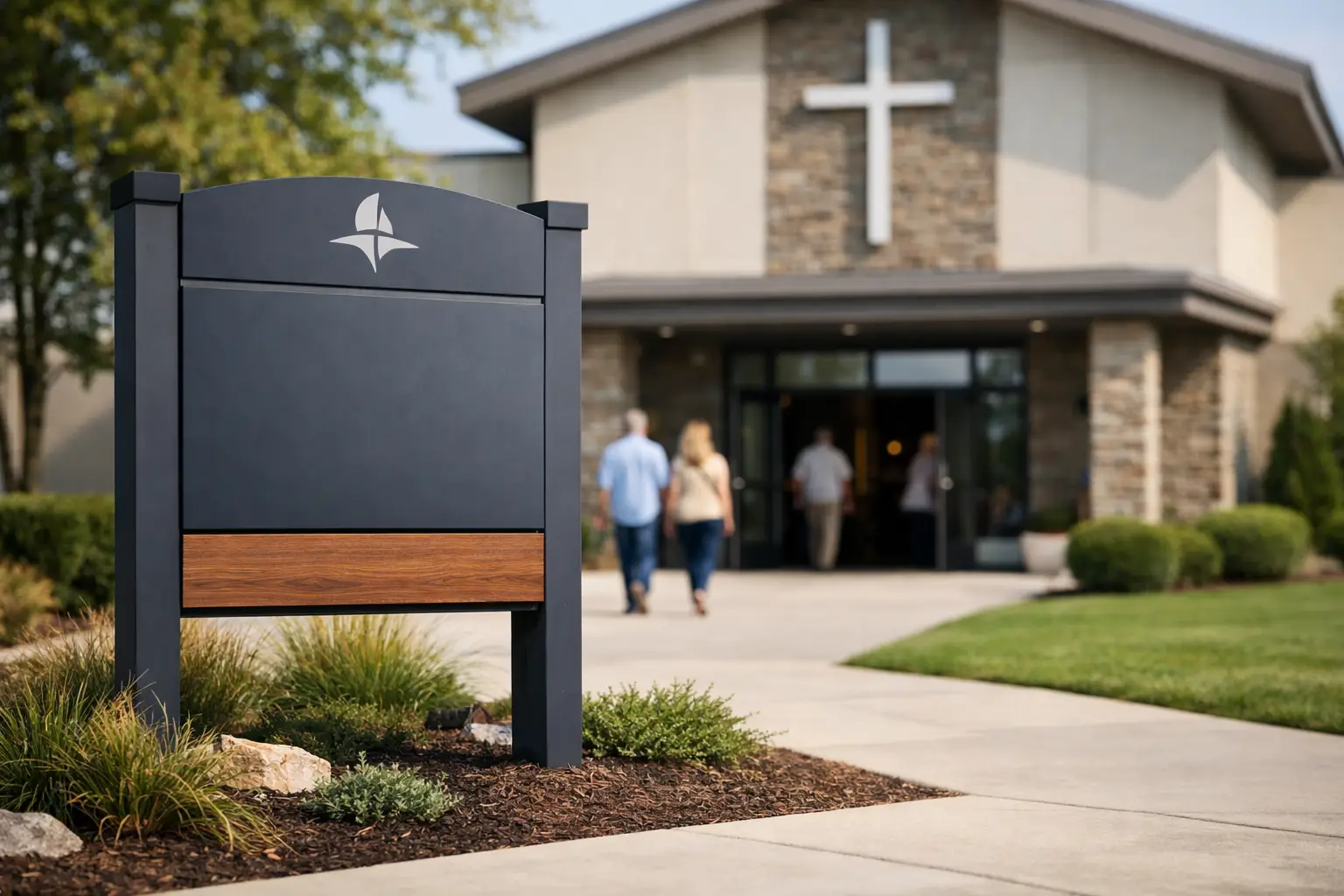
A church entrance sign design has to work long before a visitor reaches the parking lot. It should identify the property from the road, direct first-time guests with minimal hesitation, and present the congregation with the right level of permanence. Those goals are connected, but they are not solved by simply making a sign larger or adding more information.
The strongest entrance signs begin with actual site conditions: vehicle speed, road setback, landscaping, available sign area, local restrictions, and the distance from which the copy must be read. From there, the design can be built around a hierarchy that is visible, manufacturable, and appropriate for the architecture of the campus.
Start With What the Sign Must Do
Many church entrance signs are asked to perform too many jobs at once. A property may need its church name, denominational affiliation, service times, an address, a welcome message, directional arrows, and room for changeable announcements. Trying to give every item equal weight usually produces a crowded sign that is difficult to read from a vehicle.
Decide first whether the sign is primarily an identification sign, a wayfinding sign, or a message sign. An entrance monument near a public road generally needs the church name to do most of the work. Service times and a short location identifier may be appropriate secondary copy. A separate directional sign farther into the property can handle parking, office, preschool, chapel, or event entrance information more effectively.
This separation matters because readable signs depend on hierarchy. The church name should be the largest visual element. A recognizable logo, cross, or emblem can support it, but it should not compete with the primary copy. Secondary text needs enough contrast and letter height to be useful, not merely present.
Readability Depends on Distance and Speed
A sign viewed by drivers traveling 35 to 45 mph needs fewer words, larger letters, and clearer contrast than a sign at the end of a slow internal drive. This is where otherwise attractive artwork often fails in the field. Fine script, narrow strokes, low-contrast colors, and long lines of copy may look refined on a screen but disappear at road distance.
As a practical design approach, treat the sign face as a sequence of visual decisions. The viewer should recognize the church name first, then the property type or service information if time allows. If the full message cannot be understood in a few seconds, reduce the copy rather than shrinking every letter.
Letter style also affects performance. Bold serif and sans-serif typefaces generally hold up well for primary copy. Script fonts can work for a short word or accent line, but they are rarely the right choice for a long church name viewed from the street. Before production, fonts should be converted to outlines in the approved vector artwork so their exact shapes are preserved.
Choose a Church Entrance Sign Design That Fits the Site
The sign should feel connected to the building and grounds without becoming a miniature copy of the sanctuary. A traditional brick church may suit a formal routed panel with dimensional raised lettering, a carved border, and restrained colors. A contemporary campus may call for clean dimensional letters, a simplified logo component, and a metal-faced or acrylic accent.
Material and profile choices should support that direction. Sign-grade 15-pound HDU is a strong option for routed exterior sign panels because it can be carved, shaped, textured, and finished without the grain movement, checking, or rot concerns associated with natural wood. It is especially useful when the design includes recessed backgrounds, raised copy, routed borders, simulated woodgrain, or layered emblems.
HDU is not the only answer for every component. Acrylic can provide crisp dimensional letters and smooth color. PVC may suit certain layered elements. Metal-faced components can introduce a more architectural appearance where the design and budget call for it. The correct combination depends on the desired finish, installed environment, structural method, and how much dimensional depth the sign needs.
A monument sign may use an HDU replacement face within an existing masonry or metal cabinet. A freestanding routed panel may mount between posts or attach to a prepared sign structure. Building-mounted entrance letters require different attachment planning than a panel installed in a landscaped monument. The sign design should identify that distinction early, because fabrication dimensions and mounting preparation depend on it.
Color, Contrast, and Finish Are Functional Choices
Church colors often have historical or emotional value, but exterior visibility still has to lead. Dark copy on a light background or light copy on a dark background is usually easier to read than colors with similar value. A subtle tonal contrast may look elegant in a proof yet become weak under overcast skies, glare, or shade from mature trees.
Specify colors clearly using recognized color references when possible. A verbal description such as “deep blue” leaves too much room for interpretation, especially when dimensional letters, routed backgrounds, and logo components use multiple finishes. The approved artwork and written scope should identify background color, letter color, border color, logo colors, and any metallic or specialty finish requirements.
Finish texture should be intentional as well. A routed woodgrain background can add warmth to a traditional church sign, while a smooth background may better fit modern architecture. Texture should not reduce contrast around the copy. Raised letters need clean edges and sufficient relief so they remain distinct from the panel face in changing daylight.
Design for Fabrication, Not Just the Proof
A polished rendering is only the beginning of a custom sign project. The production file must provide usable information: overall dimensions, panel thickness, recess depth, raised-letter height, border clearances, color specifications, and the exact relationship between all components. Vector files are preferred because they allow precise CNC routing and accurately define curves, lettering, and logo shapes.
Small details deserve particular attention. A thin line may be too fragile to route or finish consistently at the selected scale. Letter spacing that looks acceptable in artwork may close up after a dimensional profile is added. A logo with tiny internal cutouts may need simplification to remain readable and durable. These are not reasons to abandon the concept. They are reasons to adjust it before fabrication begins.
For multi-part signs, determine whether lettering and emblems will be integral to the routed panel, fabricated as separate dimensional components, or combined in layers. Layering adds depth and visual interest, but it also affects thickness, packaging, field alignment, and installation labor. A simple single-panel design may be more appropriate when the installer needs a straightforward replacement face. A layered assembly may be worth the added coordination for a prominent main entrance.
Confirm the Installation Interface
Custom manufacturing and site installation are separate responsibilities unless a written scope states otherwise. The customer, contractor, or installer must verify field measurements, structural conditions, code requirements, and the attachment method before production. This is particularly important for monument replacements, where existing frames may not be square, and for post-mounted panels, where post spacing and hardware locations control the finished fit.
Provide the manufacturer with confirmed overall dimensions, mounting-hole locations if holes are required, trim clearance, and photographs or drawings of the existing sign structure. For dimensional letters, the wall substrate, mounting pattern, and installation template requirements should be established before production. Local permitting, electrical work, footing design, and structural engineering also need to be handled by the appropriate local parties.
A clear written scope protects the project. It should state what is being fabricated, the material selections, finished dimensions, colors, included mounting preparation, and whether the order consists of a complete sign face, routed panel, individual letters, or logo components only. That clarity prevents a common problem: assuming a fabricated component includes structural support, installation hardware, or field services that were never specified.
Build in a Deliberate Approval Process
Before routing starts, review the proof at full attention, not as a quick email attachment. Check spelling, service times, addresses, logo orientation, color callouts, and overall dimensions. Confirm that the primary copy is large enough for the intended viewing distance. If the church has multiple decision-makers, establish one person who can consolidate changes and provide final approval.
This step is where design intent becomes production accountability. Once the artwork is approved, the fabrication team can route the panel and components to the stated specifications, apply the required finishes, inspect the work, and package it for shipment. At HDU Signs, that manufacturing discipline is centered on defined materials, approved artwork, and a documented scope rather than generic sign templates.
A church entrance sign is often the first physical welcome a guest receives. Give it enough planning to be readable from the road, detailed enough to reflect the congregation, and specified clearly enough that the finished components arrive ready for the installation plan already in place.