HDU Material Benefits for Exterior Signage
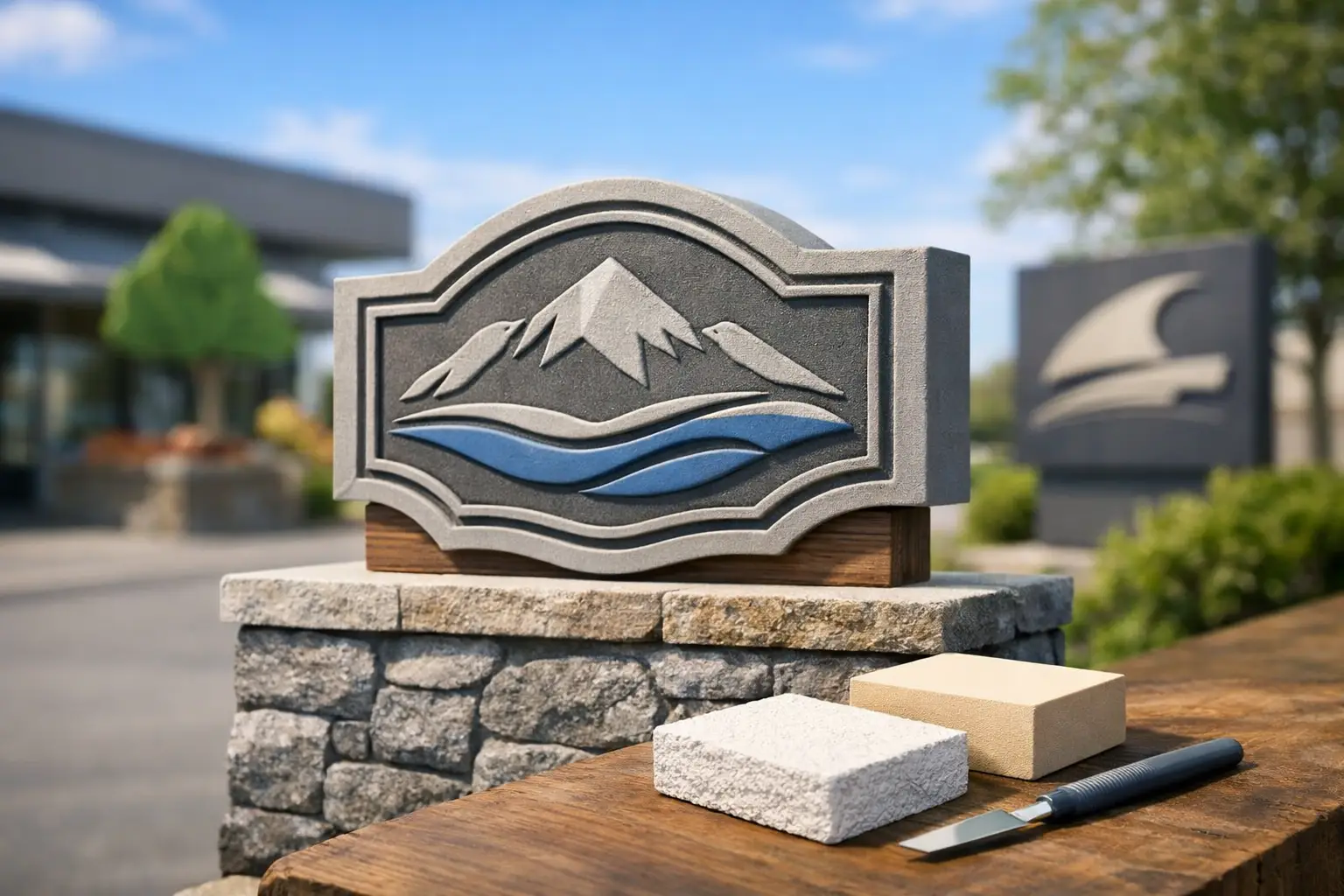
A sign panel can look excellent in the shop and still become a problem after a season outdoors if its material moves, checks, or loses its finish. The practical HDU material benefits begin with dimensional stability: sign-grade high-density urethane provides a dependable base for carved details, raised copy, custom borders, and layered exterior components without the grain movement associated with natural wood.
For a business entrance, church sign, HOA monument, or commercial property identifier, that stability affects more than appearance. It affects how well lettering stays aligned, how consistently a routed panel accepts finish, and whether the approved design can be manufactured to the intended dimensions. HDU is not the right answer for every sign application, but it is a highly capable material when the project calls for durable, dimensional exterior fabrication.
Why 15-Pound Sign-Grade HDU Performs Differently
HDU is a closed-cell urethane board manufactured in different densities. For exterior dimensional signage, 15-pound sign-grade HDU offers a useful balance of strength, carving quality, weight, and workability. It is dense enough to produce crisp routed features while remaining substantially easier to machine and handle than many solid wood or metal assemblies.
Unlike wood, HDU has no grain direction. That matters when a CNC router cuts a fine serif, a shallow recessed background, or a decorative profile around the perimeter of a panel. Wood grain can introduce variation into the cut and can create points where moisture-related expansion, contraction, checking, or splitting becomes visible over time. HDU provides a more uniform substrate, allowing the routed geometry to follow the approved vector artwork more predictably.
This does not mean every detail should be made extremely small. Exterior signs are viewed at distance, often from vehicles, and need enough stroke width, spacing, and depth to remain readable after finishing. A good HDU design uses the material's routing capability in service of visibility rather than adding detail that cannot be seen from the intended viewing distance.
HDU Material Benefits for Carved and Dimensional Designs
The strongest reason to specify HDU is its flexibility as a fabricated sign material. A single panel can be routed with a recessed field, raised lettering, an incised border, and a custom top profile. Separate HDU elements can also be layered to create depth that would be difficult or costly to achieve with flat printed signage.
Clean routing supports accurate visual hierarchy
Dimensional signs need a clear order of information. A property name may be the most prominent element, while an address, suite range, tenant list, or secondary message plays a supporting role. CNC routing makes it possible to control letter height, relief depth, border width, and spacing with repeatable precision.
For example, a monument replacement face may use raised primary copy over a recessed background, with a contrasting border and separate address numerals. The result is not simply more decorative. The physical depth creates shadow lines and visual separation, helping important information read more clearly under changing daylight conditions.
It accommodates custom shapes without wood-related instability
Arched tops, shield shapes, sandblasted-style textures, routed borders, and logo profiles are common reasons customers choose HDU. The material can be machined into these forms without relying on laminated wood blanks or working around knots and grain patterns.
That consistency is especially valuable when a project includes multiple matching signs. A multi-building campus, subdivision, church property, or commercial center may need several panels with the same profile and brand elements. Once the artwork, dimensions, and routing program are approved, the components can be produced to a controlled specification.
Its weight can simplify handling and installation planning
HDU is lighter than many comparable solid-wood sign assemblies. That can make shipping, staging, and installation handling more manageable, particularly for larger routed panels and dimensional logo components. It does not eliminate the need for proper structural planning.
The customer or installer must still verify field measurements, mounting surfaces, post conditions, wind exposure, attachment methods, and local code requirements. A lightweight panel can still require substantial support if it is large, elevated, exposed to wind, or part of a freestanding sign structure.
Exterior Durability Depends on the Full Build
HDU does not absorb moisture like wood, so it avoids a major source of exterior material movement. This makes it a strong choice for painted and textured sign faces exposed to rain, humidity, and temperature changes. In Georgia and across the United States, that resistance to moisture-related swelling and cracking is a meaningful advantage for exterior sign construction.
Still, material selection is only one part of finished-sign durability. Routing quality, primer, paint system, edge treatment, assembly method, and attachment hardware all matter. A panel with carefully routed features needs a compatible finishing process that covers faces, edges, and recessed areas consistently. Deep recesses and tight interior corners require particular attention because they can retain overspray, shadow finish coverage, or collect debris if the design is not properly considered.
Color choice matters as well. Dark colors can absorb more heat than light colors, particularly in direct sun. Large dark-faced panels, thin profiles, and high-exposure locations deserve a realistic discussion of design, substrate thickness, mounting, and finishing before production begins. Durability is strongest when the sign is specified as a complete assembly rather than treated as a material-only decision.
Where HDU Is a Better Choice Than Other Sign Materials
HDU is often selected when a project needs carved character, raised copy, routed texture, or a custom dimensional profile. It is well suited to entrance signs, property signs, routed wall panels, dimensional logos, and monument sign replacement faces where the sign must look established and remain visually controlled outdoors.
It is not automatically the best material for every component. Acrylic may be a better choice for polished, glossy, or translucent dimensional letters. PVC can be practical for certain flat or painted interior and exterior components. Metal-faced elements may be specified when the design calls for a metallic appearance, a particular edge condition, or a different level of impact resistance.
There are also applications where HDU requires added care. Very thin, unsupported letters can be vulnerable to breakage during handling or installation. Fine details that look appropriate on a computer screen may not have enough physical strength at full scale. Long panels may require designed support points, expansion considerations in adjacent materials, or a layered construction approach. These are production questions to resolve before fabrication, not after delivery.
Specifications That Protect the Finished Result
A custom sign should be quoted and fabricated from information that can be measured. The more clearly the project is defined, the more accurately its material, routing, finish, and mounting preparation can be planned.
For an HDU sign, the production scope should identify overall width and height, material thickness, panel shape, routed features, recess depth, raised element thickness, colors, and any separate components. If the sign will mount to an existing monument frame or cabinet, the customer or installer should provide verified opening dimensions and attachment information. A replacement face that is even slightly oversized or undersized can create avoidable field problems.
Vector artwork is preferred because it defines clean paths for CNC routing. Fonts should be outlined, and logos should be supplied as usable vector geometry rather than low-resolution images. When a customer provides only a raster logo or a photograph of an existing sign, artwork cleanup may be necessary before a routing path can be approved.
Color specifications should be equally clear. A named paint color, standard color reference, or approved color sample is more reliable than descriptions such as dark blue or bronze. For multi-layer signs, identify which elements receive each color and whether the edges, sides, and backs need a specified finish. Details that seem minor at the design stage often determine whether the final sign looks intentional from every angle.
Plan for Installation Before the Panel Ships
Factory-direct manufacturing works best when production and field responsibilities are kept distinct. A fabricated HDU panel can be routed, finished, inspected, and securely packaged for shipment, but the site still determines how it must be installed. Existing surfaces may be uneven, posts may be out of plumb, and concealed mounting conditions may differ from drawings or photos.
Before ordering, confirm who will receive the shipment, inspect for freight damage, lift the components, provide hardware, and complete the installation. Confirm mounting holes, stud locations, cleat systems, or other attachment requirements in advance when they are part of the build. If no mounting method is included in the written scope, the installer should plan the attachment system based on the actual site conditions.
The most effective HDU sign projects start with a design that respects real viewing distance and end with a scope that leaves no uncertainty about material, dimensions, finish, and field responsibility. That is how the benefits of HDU remain visible long after the sign has been installed.