HDU Versus Aluminum for Exterior Signage
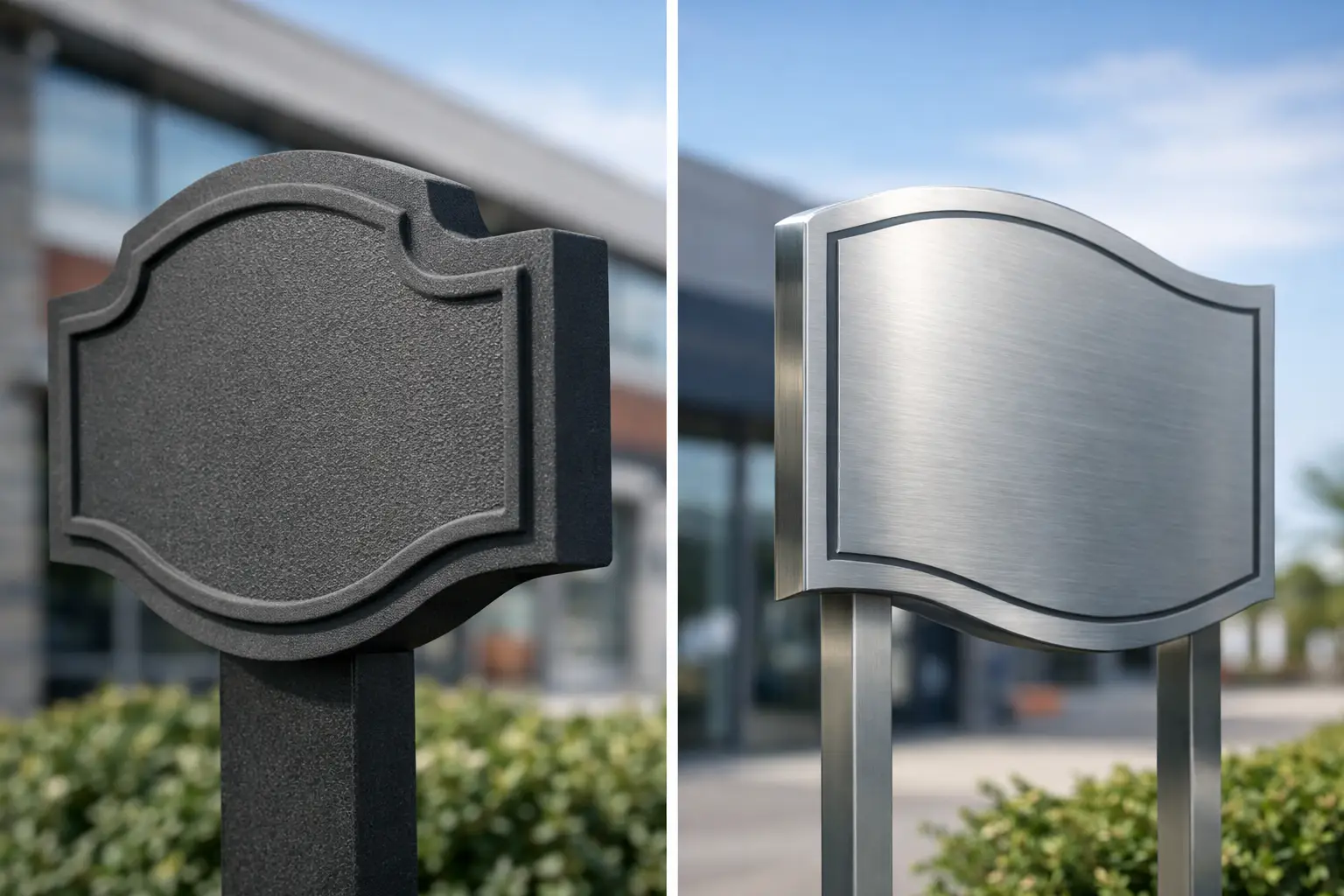
A sign face can look straightforward on an approved proof and become far more complicated once it must survive sun, rain, shipping, mounting hardware, and real viewing distances. The HDU versus aluminum decision affects more than material cost. It determines what can be routed, how much visual depth the design can carry, how the finished piece handles exterior exposure, and what the installer needs to support.
Neither material is automatically better. A flat replacement face for an existing monument cabinet has different requirements than a carved church entrance sign, a set of building letters, or a layered dimensional logo. The right choice starts with the sign's intended appearance and construction, then works back to material thickness, mounting method, finish system, and site conditions.
Start With the Sign Construction
HDU is a closed-cell polyurethane material made for carving, routing, and exterior sign fabrication. For dimensional sign work, 15-pound sign-grade HDU provides a stable substrate for recessed copy, raised copy, borders, routed textures, and custom profiles. Unlike natural wood, it does not contain grain that can telegraph through a finish, split along a routed detail, or move unpredictably as moisture changes.
Aluminum is a broad category, and that distinction matters during quoting. A thin aluminum sheet, aluminum composite material, a thicker plate, and fabricated aluminum letters do not perform the same way. Aluminum is often selected for flat panels, metal-faced elements, cabinet faces, and letters where a clean metal appearance or thin profile is part of the design intent.
The question is not simply whether HDU or aluminum will last outdoors. Properly specified examples of both can serve well in exterior applications. The more useful question is what the material must do: remain flat across a wide span, accept deep routing, create a sculpted appearance, carry a metallic finish, or attach to an existing structure with limited mounting depth.
HDU Versus Aluminum: Routing and Visual Depth
This is where the difference is most visible. HDU can be CNC routed to create depth within the material itself. A panel can include a recessed background, raised lettering, an inset logo, a dimensional border, or a woodgrain-style texture without assembling every feature as a separate part. Those details give an entrance sign or property identifier shadow lines that remain readable as light changes through the day.
The available depth depends on overall panel thickness and the design. A shallow recess may be appropriate for fine copy, while a larger sign can support deeper carved fields and more substantial raised components. Thin strokes, tight interior corners, and undersized letterforms still require review. A routed detail must be large enough to machine cleanly, finish consistently, and remain visually legible from the intended distance.
Aluminum can be CNC cut and routed, but thin sheet material does not offer the same carved relief. It is generally better suited to cut-through shapes, flat faces, and components fabricated or mounted in layers. A metal panel can deliver a crisp, architectural result, especially when paired with acrylic, PVC, or dimensional letters. It is not usually the first choice when the design calls for a deeply carved background or a substantial faux-wood profile.
For projects that need both material character and depth, a mixed-material construction can be the practical answer. An HDU base may provide the routed field and raised border, while aluminum-faced or acrylic elements add a specific finish, color contrast, or dimensional layer. The written scope should identify each component rather than treating the sign as one unspecified material.
Where HDU Is Usually the Better Fit
HDU is well suited to freestanding entrance signs, routed panels, exterior wall plaques, property identification signs, and dimensional logo components. It is especially effective when the sign needs to look crafted rather than flat. A carved panel with raised copy can establish hierarchy without relying on excessive colors or small decorative elements.
It is also a practical option when wood is part of the visual direction but wood's maintenance and movement are not acceptable. HDU can be finished to support woodgrain-style textures and painted color systems while maintaining a more consistent routed substrate. That does not eliminate the need for proper priming, painting, edge finishing, and routine condition checks. Exterior performance depends on the complete finish system, not just the panel underneath it.
Weight is another useful consideration. HDU is generally lighter than a comparably sized solid metal plate, which can simplify handling and reduce load on some mounting conditions. It is not a structural material, however. Large panels, unsupported spans, post-mounted signs, and exposed locations may require internal reinforcement, an appropriate frame, or a separate structural support system designed for the site.
When Aluminum Makes More Sense
Aluminum is often the right selection when the design requires a thin, flat panel; a true metal-facing appearance; or compatibility with an existing sign cabinet or monument frame. Replacement faces, directional panels, architectural information signs, and cut metal letters are common examples. It can provide a clean profile with little visual bulk.
For a sign face that must span an existing frame, panel stiffness and attachment layout become central production questions. The customer or installer must verify opening dimensions, support locations, fastener access, and any clearance needed for panel expansion or removal. A replacement panel that is accurately fabricated can still fail to fit if the field measurements are taken from an out-of-square opening or if an existing frame has shifted.
Aluminum also works well where a metallic finish is not merely a color but part of the intended material expression. Brushed, painted, or metal-faced elements can make sense for contemporary branding, institutional wayfinding, or building letters. If the goal is a sculpted face with deep relief, aluminum typically needs layered construction or a different fabrication approach to achieve it.
Durability Depends on the Full System
A material comparison should account for the parts that customers do not always see on a rendering. Those include coating preparation, edge treatment, attachment hardware, backing, mounting surfaces, drainage, and exposure to impact. A sign installed near irrigation, lawn equipment, traffic, or salt exposure has different risks than one under a protected entry canopy.
HDU will not rot like wood, but it can be damaged by severe impact, and routed edges must receive proper finishing. Aluminum resists corrosion well in many environments, but it can dent, scratch, and show finish damage. Dissimilar metals, poor drainage, trapped moisture, and unsuitable fasteners can create problems that are unrelated to the panel's initial appearance.
For either material, do not treat color as a casual production detail. Provide approved color references, such as standard color codes or physical samples when required. Dark colors may show surface defects more readily, while low-contrast copy can disappear at distance even when the fabrication is accurate. Readability should be evaluated at the real approach distance, not only on a screen.
Specify the Details Before Fabrication
A useful quote identifies the panel dimensions, material and thickness, routed features, paint or finish requirements, separate dimensional components, and expected attachment preparation. It should also state whether the sign is supplied as a finished panel, a set of loose letters, layered components, or a replacement face intended for a specific existing structure.
Artwork should be production-ready before routing begins. Vector files are preferred, and fonts should be outlined so the approved letterforms do not change between design and fabrication. Include final dimensions, copy placement, logo scale, recess depth where applicable, border width, mounting-hole locations, and any required trim clearance. If a logo contains fine lines or small enclosed areas, it may need adjustment to machine and finish reliably.
Mounting is not a detail to leave until shipment arrives. The customer or installer must verify measurements, wall conditions, structural support, local code requirements, and attachment methods. For panels and letters, that may include stud locations, masonry anchors, standoff hardware, raceways, adhesive compatibility, or templates. Manufacturing can be precise only when the approved production information is precise.
Choose for the Finished Sign, Not the Material Name
HDU and aluminum are both capable exterior sign materials, but they solve different visual and fabrication problems. Choose HDU when routed depth, carved detail, dimensional texture, and a substantial sign face are central to the design. Choose aluminum when a slim metal panel, flat architectural appearance, or existing cabinet application drives the project.
The strongest result comes from defining what the sign must look like, how it will mount, and what it must withstand before selecting the substrate. A clear scope, verified dimensions, and production-ready artwork give the finished sign its best chance to look intentional from the day it is installed.