HDU vs Wood Outdoor Signs for Lasting Curb Appeal
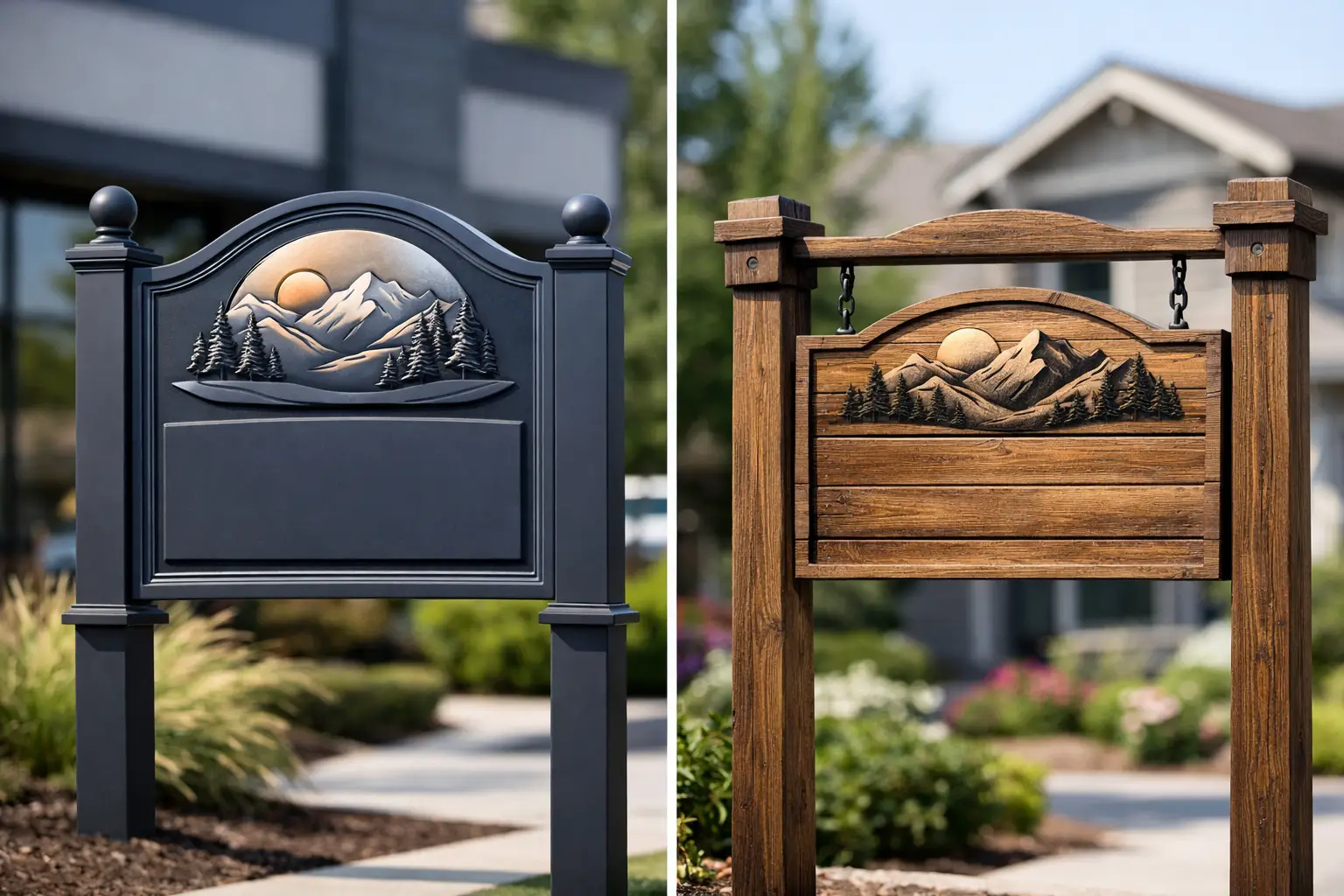
A carved entrance sign can look excellent on the day it is installed and become a maintenance problem a few seasons later. That is the practical difference behind the HDU vs wood outdoor signs decision. Both materials can create dimensional, traditional-looking signage, but they respond very differently to moisture, temperature changes, sunlight, and the detailed routing required for a finished commercial or property sign.
For a business entrance, church campus, neighborhood monument, or property identification sign, the better material is not always the one with the lowest initial price. It is the one that fits the design, the environment, the planned finish, and the level of maintenance the owner is prepared to accept.
HDU vs Wood Outdoor Signs: The Core Difference
Wood is a natural material with visible grain, variation, and a familiar handcrafted character. When it is properly selected, sealed, painted, and maintained, it can be a suitable choice for signs where authentic wood grain is part of the intended appearance. Cedar, redwood, and similar species are commonly considered because they offer better natural resistance to decay than many other woods.
HDU, or high-density urethane, is a closed-cell sign material manufactured for carving, routing, shaping, and exterior finishing. Sign-grade 15-pound HDU is dense enough to machine cleanly and hold detailed routed features while remaining far lighter than a comparable solid wood panel. It does not contain a natural grain pattern, absorb water like wood, or expand and contract in the same way.
That difference affects more than durability. It affects how the sign can be designed, fabricated, finished, mounted, repaired, and expected to age over time.
Where Wood Still Makes Sense
Wood is not automatically the wrong choice. A project may call for it when real grain, knots, or species-specific character are central to the design. A rustic lodge, historic property, trailhead, ranch, or heritage-oriented location may benefit from the visual irregularity of actual wood. No painted synthetic material reproduces every characteristic of a naturally weathered board.
Wood can also make sense when the sign will be sheltered from direct rain and strong sun, when the design is relatively simple, and when the owner understands the maintenance commitment. A covered porch sign has a very different exposure profile than a freestanding monument panel facing an open parking lot.
The limitation is that natural beauty also brings natural variability. Wood grain can affect routing consistency and paint coverage. Boards can check, cup, split, or move as moisture conditions change. Even a well-built wood sign requires careful material selection, edge sealing, priming, and periodic inspection. End grain, seams, fastener locations, and carved recesses deserve particular attention because these areas can admit moisture first.
Why HDU Is Often Specified for Exterior Signage
HDU is frequently chosen for exterior dimensional signage because it provides a more controlled manufacturing surface. A CNC router can carve letters, borders, textures, logos, and background recesses without encountering knots, grain direction, or hidden voids. That consistency matters when a sign includes detailed artwork, small copy, multiple depths, or repeated branded components.
Because 15-pound sign-grade HDU does not absorb moisture, it avoids the swelling, rotting, and grain-driven movement associated with wood. It is also resistant to insects. These characteristics make it particularly useful for freestanding property signs, routed monument faces, building identification panels, and dimensional logo elements that will remain outdoors year-round.
HDU is not maintenance-free. Its finish system still matters. Exterior paint can fade, become dirty, chip from impact, or deteriorate over time based on sun exposure and local conditions. A sign should be inspected periodically, and damage to the coating should be addressed before it becomes more extensive. The difference is that the substrate is generally more dimensionally stable once the finish needs attention.
For many commercial and institutional projects, that stability provides a clearer path to long-term ownership. The owner is maintaining the finish rather than managing a material that may also be warping, splitting, or retaining moisture beneath that finish.
Appearance Depends on the Design Intent
A common concern is whether HDU can look like wood. It can be routed with a wood-grain texture and finished to create a traditional carved-sign appearance. With the right background texture, raised lettering, border treatment, and paint colors, HDU can deliver the visual warmth many owners associate with a carved wood sign.
Still, a simulated grain and genuine wood are not the same thing. If the sign concept depends on visible natural grain, stained boards, or a live-edge character, wood may remain the more visually honest material. If the goal is a clean, carved, painted sign with dependable geometry and repeatable production, HDU is often the stronger fit.
This is also where viewing distance should guide the decision. From a road or parking lot, letter height, color contrast, line spacing, and overall sign proportion matter far more than whether the background grain is natural or routed. A beautiful texture does not compensate for copy that is too small to read at the intended distance.
Routing Detail, Lettering, and Dimensional Construction
HDU gives fabricators broad flexibility for dimensional work. A routed panel can have recessed copy, raised letters, a prismatic border, textured background fields, carved logos, or multiple panel layers. Separate HDU elements can also be combined with acrylic, PVC, or metal-faced components when the design calls for contrasting finishes or added depth.
Wood can be routed as well, but its grain direction can influence fine details. Small sharp corners, narrow strokes, and closely spaced lettering may be more vulnerable to chipping or visual inconsistency, particularly as the sign weathers. This does not prevent quality wood fabrication, but it requires more design restraint and material awareness.
For either material, approved artwork should establish the actual production scope. Vector files are preferred for logos and lettering, with fonts outlined before fabrication. The drawing should identify overall dimensions, panel thickness, copy placement, recess depth, color codes, border widths, and any separate dimensional components. If mounting holes, studs, or site-specific attachment details are required, those should be defined before production rather than assumed after the sign ships.
Weight, Structure, and Installation Considerations
HDU is significantly lighter than solid wood, which can simplify handling and reduce load on a support structure. That can be useful for replacement monument faces, large routed panels, and layered building signs. Lighter does not mean structurally self-supporting, however. A large sign still requires an appropriate backing system, frame, posts, or mounting surface for its size, wind exposure, and installation method.
Wood may be heavier, especially in thicker solid panels. It can also require more careful evaluation of how the panel is supported as it changes with age and moisture exposure. A wood sign attached too rigidly at multiple points may be more prone to stress as the material moves.
Manufacturing and installation are separate responsibilities unless a written scope states otherwise. The customer or installer must verify field measurements, wall conditions, post spacing, structural capacity, local permit requirements, and attachment methods. A correctly fabricated sign cannot correct an unverified opening, an uneven monument structure, or inadequate site hardware.
Cost Should Be Measured Beyond the First Invoice
The upfront price of HDU and wood outdoor signs varies with thickness, dimensions, artwork complexity, finish, layering, and quantity. A simple wood panel may initially cost less than a detailed HDU sign. A premium wood species with extensive carving, sealing, and finishing may cost more than expected. Material cost alone does not tell the whole story.
The useful comparison is lifecycle cost. Consider the likely maintenance schedule, access required for repainting, potential for repairs, exposure to moisture, and the cost of replacing the sign if the substrate fails. A sign at a street entrance or elevated monument may be expensive to remove and reinstall, making long-term stability more valuable than a small initial savings.
HDU is generally the more predictable choice where the sign needs routed detail, painted finishes, stable dimensions, and reliable exterior performance. Wood earns its place where authentic natural material is a defining part of the visual identity and the owner accepts the care that comes with it.
Before selecting either material, define the sign's viewing distance, exposure, dimensions, finish expectations, attachment method, and maintenance plan. A clear production scope turns the material decision from a matter of preference into a sign specification that can perform at the property for years.