HOA Monument Sign Makeover: What to Specify
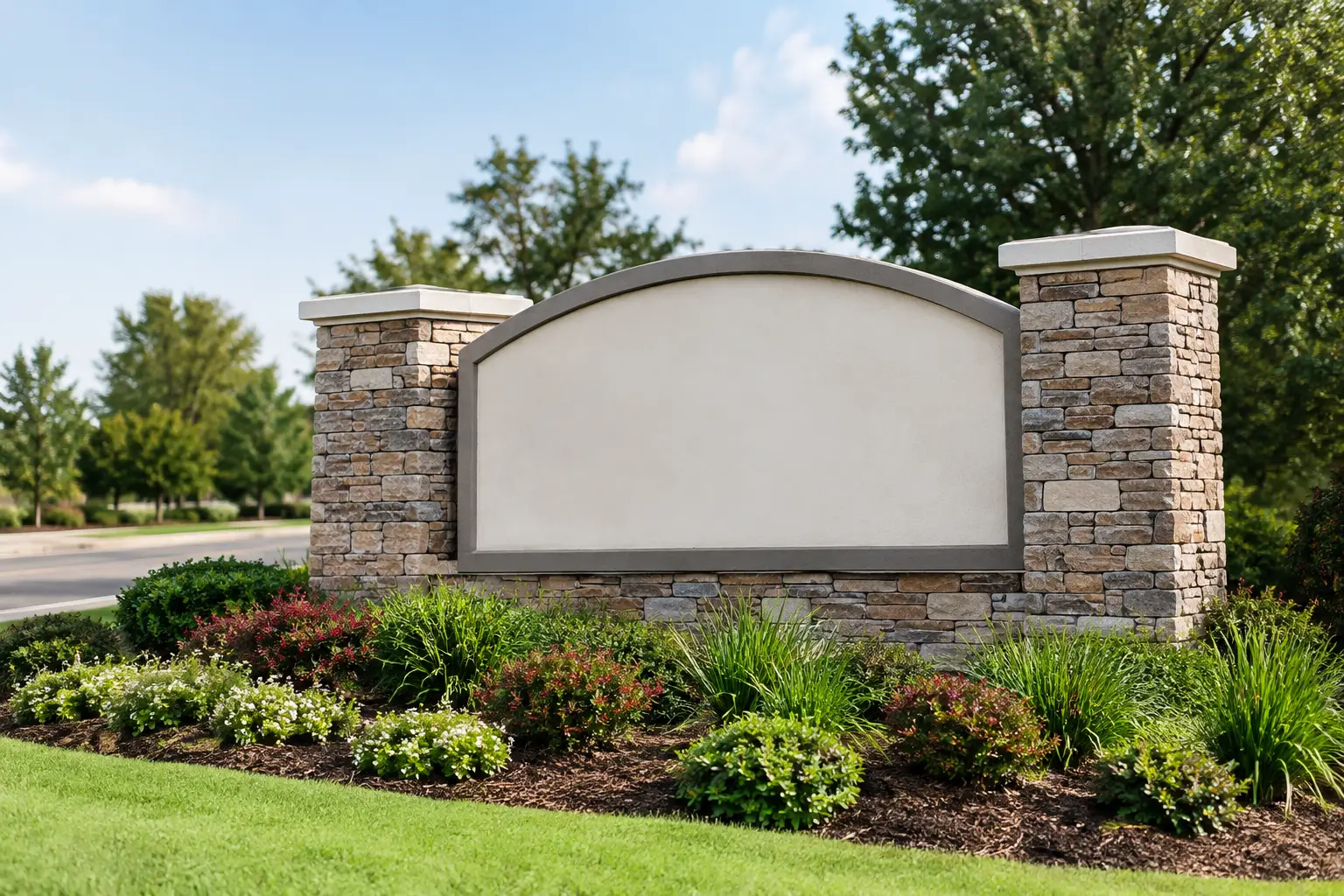
A faded entrance sign can make a well-maintained neighborhood look neglected before a visitor reaches the first home. An HOA monument sign makeover is not simply a matter of choosing a new color or adding a logo. The sign has to identify the community quickly, hold up outdoors, fit the existing structure accurately, and arrive with a clear division between fabrication work and site installation.
For HOA boards and property managers, the best projects begin by defining what can stay, what must be replaced, and what the finished sign needs to accomplish from the road. That early clarity prevents a common problem: ordering an attractive replacement face that does not match the monument opening, attachment method, or real viewing distance.
Start With the Existing Monument, Not the Artwork
A monument sign may have a sound masonry base and an outdated sign face, or it may have concealed water damage, loose framing, failed fasteners, and a panel that has warped beyond practical reuse. Those conditions call for different scopes of work. Before approving a design, inspect the entire assembly rather than judging the project from the front elevation alone.
Measure the visible sign opening, but also measure the overall panel, border clearance, recessed pocket depth, frame depth, and the locations of every existing attachment point. Photograph the sign straight on, from each side, and from the back if it is accessible. If the monument includes an arched top, stone irregularities, or a recessed mounting area, record those details as well.
The customer or installer must verify field measurements before fabrication. A manufacturer can produce a replacement face to approved dimensions, but cannot confirm whether an older monument is square, structurally sound, or modified in the field. This distinction matters most when a new panel must fit inside an existing brick, stucco, stone, or concrete opening.
It is also useful to decide whether the goal is a replacement face or a more complete visual rebuild. A replacement face preserves the existing monument structure while updating its graphic surface. A fuller makeover may add raised lettering, a dimensional community logo, routed borders, layered panels, or new address elements. Both approaches can work well, but the budget, shipping size, mounting plan, and installation labor are different.
HOA Monument Sign Makeover Priorities: Readability First
A sign is not successful because it looks detailed at arm's length. It is successful when drivers and visitors can recognize the community name at the actual approach speed and viewing distance.
Start with the community name. It should be the largest element, with enough contrast against the background to remain legible in bright daylight, overcast conditions, and evening headlights. Decorative scripts can reflect a neighborhood's character, but they often become difficult to read when reduced to monument-sign scale. A more readable serif or sans-serif typeface may be the better choice for the primary name, while a script can be reserved for a smaller secondary phrase.
Avoid treating every line of information as equally important. Community names, street addresses, and required directional information have different jobs. If the name is the priority, it needs visual dominance. If an address is needed for emergency response or deliveries, it should be large enough to function independently rather than squeezed into a narrow line below the logo.
Color should support contrast, not compete with it. A deep green panel with cream raised letters may suit a traditional community. A charcoal background with light gray or white copy can give a newer development a more restrained appearance. Exact paint colors should be identified by accepted color codes when possible, especially if the HOA is matching other entrance features, wayfinding signs, or clubhouse branding.
Select Materials for Exterior Use and the Existing Structure
For carved and dimensional monument components, 15-pound sign-grade HDU is a practical material choice. It is stable, routable, and suited to raised lettering, recessed backgrounds, custom borders, and carved textures. Unlike natural wood, HDU does not have grain movement, checking, or rot concerns that can compromise a painted exterior sign over time.
Material selection still depends on the design. A routed HDU panel may be the right solution for a classic community entrance with a carved border and raised copy. Dimensional acrylic letters can provide crisp edges and strong color contrast. PVC may be useful for certain layered elements, while metal-faced components can add a more architectural finish where the design calls for it.
The key is to specify the intended appearance and construction rather than asking for a generic “weatherproof sign.” Exterior durability comes from the correct combination of material, panel thickness, routed depth, paint system, edge treatment, attachment method, and installation conditions. A thin panel with large unsupported spans may need reinforcement. Raised letters need enough thickness and contrast to create visible shadow lines without becoming fragile during handling or installation.
Textured finishes deserve careful consideration. A woodgrain or sandblasted-style texture can add character to a residential entrance sign, but it can also reduce contrast if the paint colors are too similar. Smooth painted fields often work better for small text and street numbers. The most effective designs use texture selectively, where it strengthens the community character without interfering with readability.
Define the Fabrication Scope Before Production
Custom sign work becomes more predictable when the approved scope describes the physical product in specific terms. That scope should identify panel dimensions, thickness, shape, background color, letter color, logo treatment, border details, recess depth, and any separate dimensional components.
For a replacement monument face, include whether the panel is intended to mount flush, sit within a recessed pocket, or attach to an existing frame. If hardware holes are required, provide their locations, diameter, and center-to-center spacing. Do not assume a new panel can reuse old holes without verification. Existing anchors may be damaged, misaligned, or positioned differently from the new design.
Artwork should be production-ready before final approval. Vector files are preferred because they preserve clean edges for CNC routing and allow lettering, logos, borders, and shapes to be scaled accurately. Fonts should be outlined in the final artwork. If the HOA only has a raster image, such as a low-resolution logo pulled from a website, it may need to be redrawn before it can be fabricated cleanly.
A proof is the point to confirm spelling, line breaks, logo proportions, colors, and dimensions. It is not merely a design formality. Once artwork is approved for production, every routed line and painted element follows that approved layout. Boards should designate one person to consolidate feedback so that contradictory revisions do not delay the job or create uncertainty around final authorization.
Plan for Installation, Permits, and Shipping
Fabrication and installation are separate responsibilities unless a written quote says otherwise. A custom manufacturer can quote, fabricate, inspect, package, and ship finished components. The customer, contractor, or sign installer typically handles permit requirements, site access, removal of existing sign faces, structural repairs, mounting hardware, electrical work, and final installation.
This separation is especially relevant for HOAs because entrance signs are often located near public rights-of-way, landscaped islands, irrigation lines, and utilities. Local sign regulations may control sign area, height, setback, illumination, and permitted copy. A replacement face may be treated differently than a new monument, but that depends on the local authority and the extent of the project.
Before delivery, confirm who will receive the shipment, where it can be stored safely, and whether the installer has the equipment needed to handle larger panels. Finished faces and dimensional components should remain protected until the installation crew is ready to mount them. Inspect the shipment on arrival and compare it with the approved scope before removing protective packaging or scheduling final work.
Common Decisions That Affect Cost and Results
A board can often control cost without reducing sign quality by making a few decisions early. Retaining a structurally sound monument base is usually less expensive than rebuilding masonry or concrete. Simplifying a logo with very fine internal details may improve legibility and reduce production complexity. Choosing a well-proportioned panel with fewer, larger elements can also produce a stronger result than packing the available space with information.
There are times when spending more is justified. If the existing face is cracking, undersized, or visually lost against a busy entrance, a simple repaint may only postpone the problem. If a neighborhood has recently improved its landscaping, gates, clubhouse, or streetscape, the entrance sign should be designed as part of that larger property presentation rather than as an isolated panel.
HDU Signs approaches these projects as manufactured sign components with defined specifications, approved artwork, inspection, and protective packaging for shipment. That process gives boards, managers, and installers a documented basis for comparing the finished product with what was approved.
A well-planned monument sign does more than refresh an entrance. It gives residents a point of pride, helps visitors find the property, and provides an exterior identifier built around real dimensions, readable design, and a scope that everyone involved can act on.