How Monument Sign Replacement Faces Should Be Specified
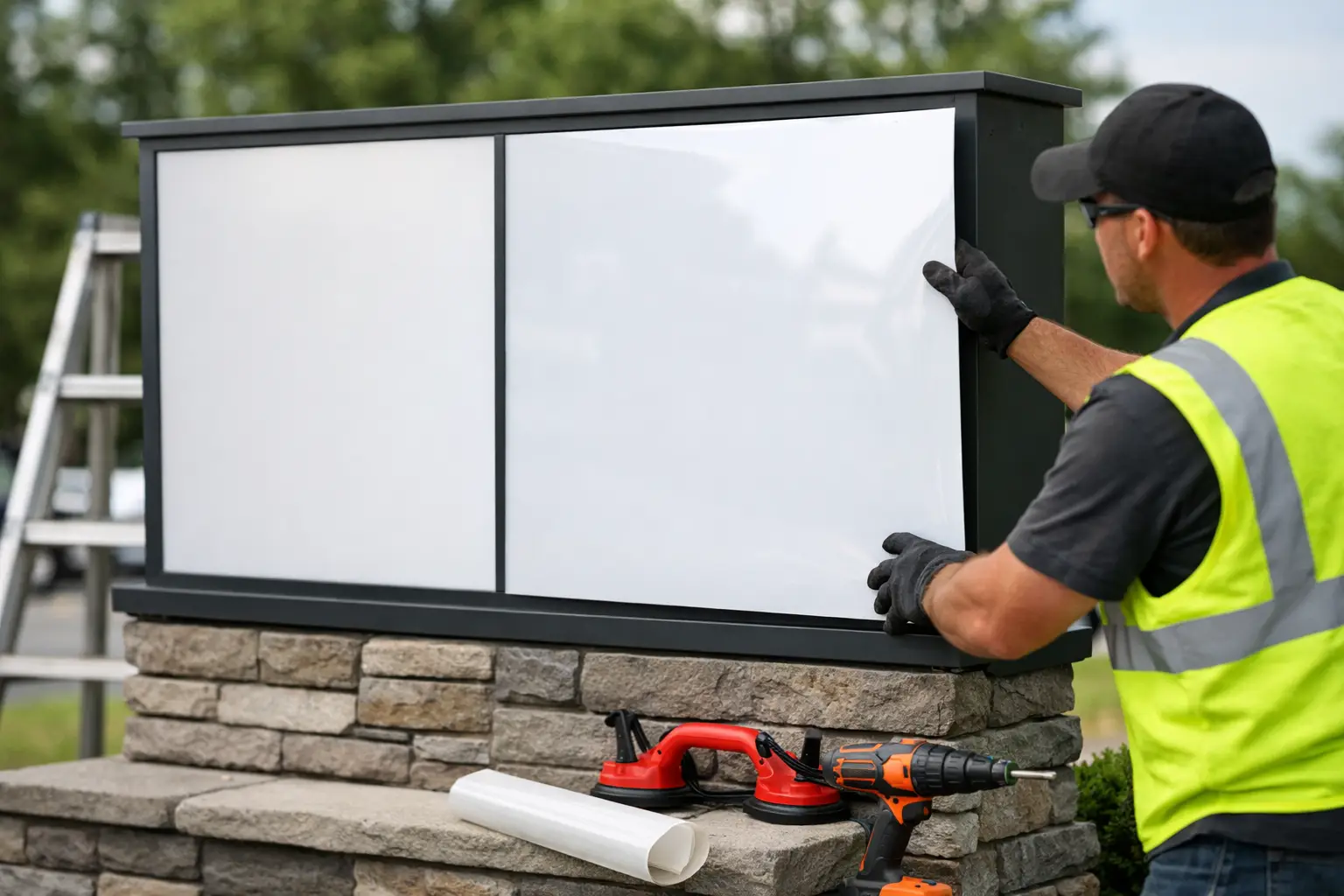
A monument sign can remain structurally sound long after its visible face has become faded, cracked, outdated, or difficult to read. Replacing the display panel instead of rebuilding the entire structure is often the practical choice, but monument sign replacement faces only work when the new component is designed around the existing opening, attachment system, and viewing conditions. A panel that looks correct in a proof can still become an expensive problem if its dimensions, thickness, mounting details, or edge clearances are assumed rather than verified.
For property managers, churches, HOAs, contractors, and sign professionals, the replacement process begins with a clear distinction: the sign face is the manufactured visual component, while the monument base, internal frame, field conditions, permits, and installation are separate responsibilities unless specifically included in the written scope. That distinction keeps a replacement project predictable from measurement through final installation.
Start With the Existing Monument Structure
The first question is not what color the new face should be. It is what the existing monument can accept. Some signs use a routed panel mounted over a masonry or concrete base. Others have recessed panels set into a frame, layered faces attached to a structural substrate, or dimensional letters and logos installed directly on a prepared background.
Before fabrication, the customer or installer must verify the overall opening size, usable mounting area, panel thickness, and placement of any existing fasteners or mounting hardware. Measure the actual structure, not only an old drawing or the panel being removed. Older faces may have warped, expanded, been trimmed in the field, or been installed with uneven reveals.
A complete field survey should identify the finished width and height required, the depth available for the new face, and whether the panel needs to sit flush, overlap an opening, or fit inside a recessed pocket. It should also document the condition of the base. Loose framing, deteriorated wood backing, damaged masonry, or an out-of-square opening can affect installation even when the replacement face is fabricated accurately.
Photographs are useful when they show the full monument, close-ups of attachment points, and a tape measure against the opening. They do not replace dimensions, but they help clarify trim conditions, returns, existing borders, and potential obstructions. If the replacement will be installed by a third party, that installer should confirm the measurements and attachment approach before production begins.
Choosing Materials for Monument Sign Replacement Faces
Material selection should reflect the sign's location, design, and desired visual depth. For non-illuminated monument faces, 15-pound sign-grade HDU is a strong option when the design calls for routed texture, recessed copy, raised lettering, dimensional borders, or custom profiles. Unlike natural wood, HDU does not rot, split, or react to moisture in the same way, making it well suited to exterior sign fabrication.
HDU also supports a wide range of visual treatments. A panel can be carved with a woodgrain or stone-like texture, routed with a recessed background, and fitted with raised HDU, acrylic, PVC, or metal-faced lettering. This allows the replacement face to preserve an established architectural style or give an aging monument a more current appearance without changing the base itself.
That does not mean HDU is the answer for every project. Flat acrylic or PVC components may be appropriate for certain clean-lined designs. Metal-faced elements can add contrast and a more architectural finish. The right material depends on the required thickness, finish, attachment method, exposure, and design intent.
A replacement face should also be designed for the way water moves across the monument. Exposed horizontal edges, unsealed penetrations, and poorly planned overlaps can shorten the service life of an otherwise well-made panel. Material choices and edge treatments should be discussed as part of the fabrication scope, not after the layout has been approved.
Design for Reading Distance, Not Just the Proof
A monument sign usually serves drivers, pedestrians, or both. The organization name, property name, address, tenant information, or directional copy must be readable at the distance and speed that matter on site. A detailed logo may be appropriate, but it should not compete with the primary message.
Replacement projects sometimes inherit a crowded design from an older face. This is a good time to evaluate whether every line of copy still belongs on the sign. A cleaner layout with stronger letter size and contrast can improve curb appeal more than adding extra decoration.
Color contrast is equally important. Dark raised letters on a light background, or light letters on a darker field, generally provide clearer viewing than similar values placed together. The final color should be specified using approved color references whenever possible. Terms such as “navy,” “bronze,” or “cream” leave too much room for interpretation in a custom production process.
Borders, routed textures, and dimensional layers can create a more finished sign, but they consume space. A wide border may reduce the usable copy area. Deep recesses and stacked components add visual interest, yet they also affect thickness, weight, packaging, and installation. The design should balance appearance with the physical limits of the existing monument.
Artwork and Production Details That Prevent Rework
Vector artwork is preferred for monument sign replacement faces because it allows the production team to scale, route, and position shapes accurately. Files should include outlined fonts so the intended letterforms do not change when opened on another system. Logos, lettering, borders, and routed areas should be clearly separated and identified.
A production-ready approval should define more than the visible layout. It should state the overall panel dimensions, material thickness, background treatment, letter height, recess depth where applicable, colors, and whether lettering or logos are raised, recessed, or applied. If multiple layers are involved, the approval should make their relationship clear.
Mounting preparation deserves the same attention. A panel may require predrilled holes, a blank margin for field fastening, concealed attachment provisions, or separate dimensional components that the installer mounts after the main face is secured. The best method depends on the substrate and site conditions. A manufacturer can fabricate to the specified mounting plan, but the customer or installer remains responsible for determining whether that plan is appropriate for the existing structure.
Do not assume that a replacement face can reuse every old hole. The old pattern may be poorly located, corroded, or incompatible with the new material thickness and design. If existing holes must be used, provide their precise center-to-center locations from a verified field measurement.
A Clear Fabrication Scope Matters
Custom sign manufacturing is not a generic off-the-shelf purchase. The quote and approved proof should establish exactly what will be produced: the panel, dimensional letters, logo components, finish, mounting preparation, and any separate pieces included for shipment. It should also identify what is not included, such as demolition of the old face, structural repair, electrical work, permits, freight unloading equipment, or installation.
This level of clarity protects the project on both sides. The fabricator can build to defined dimensions and approved artwork. The buyer, contractor, or installer can plan labor and site preparation around the actual product being shipped.
At HDU Signs, replacement faces are manufactured as made-to-order sign components, with CNC routing, finishing, inspection, and protective packaging planned around the approved scope. For large panels or layered designs, shipping considerations should be addressed early. Crate dimensions, access at the delivery location, and safe handling at the job site can influence how components are divided or packaged.
When Replacement Is the Right Answer
Replacing the face is often the most cost-conscious route when the monument base is stable, the sign's footprint remains appropriate, and the organization wants a visual update without major site work. It can also be the right choice when a tenant changes, a church updates its identity, an HOA needs clearer property identification, or weather has damaged only the visible sign panel.
A full monument rebuild may be more appropriate when the base is failing, the sign is badly undersized for its viewing distance, accessibility or local code requirements have changed, or the existing structure cannot support a properly designed replacement face. Those are site and structural decisions that should be evaluated before a new panel enters production.
The best replacement face is not simply a new version of what was there before. It is a correctly measured, clearly specified component that fits the existing monument, communicates at the right distance, and gives the installer a defined path to a professional finished sign.