Sign Materials for Exterior Signs That Last
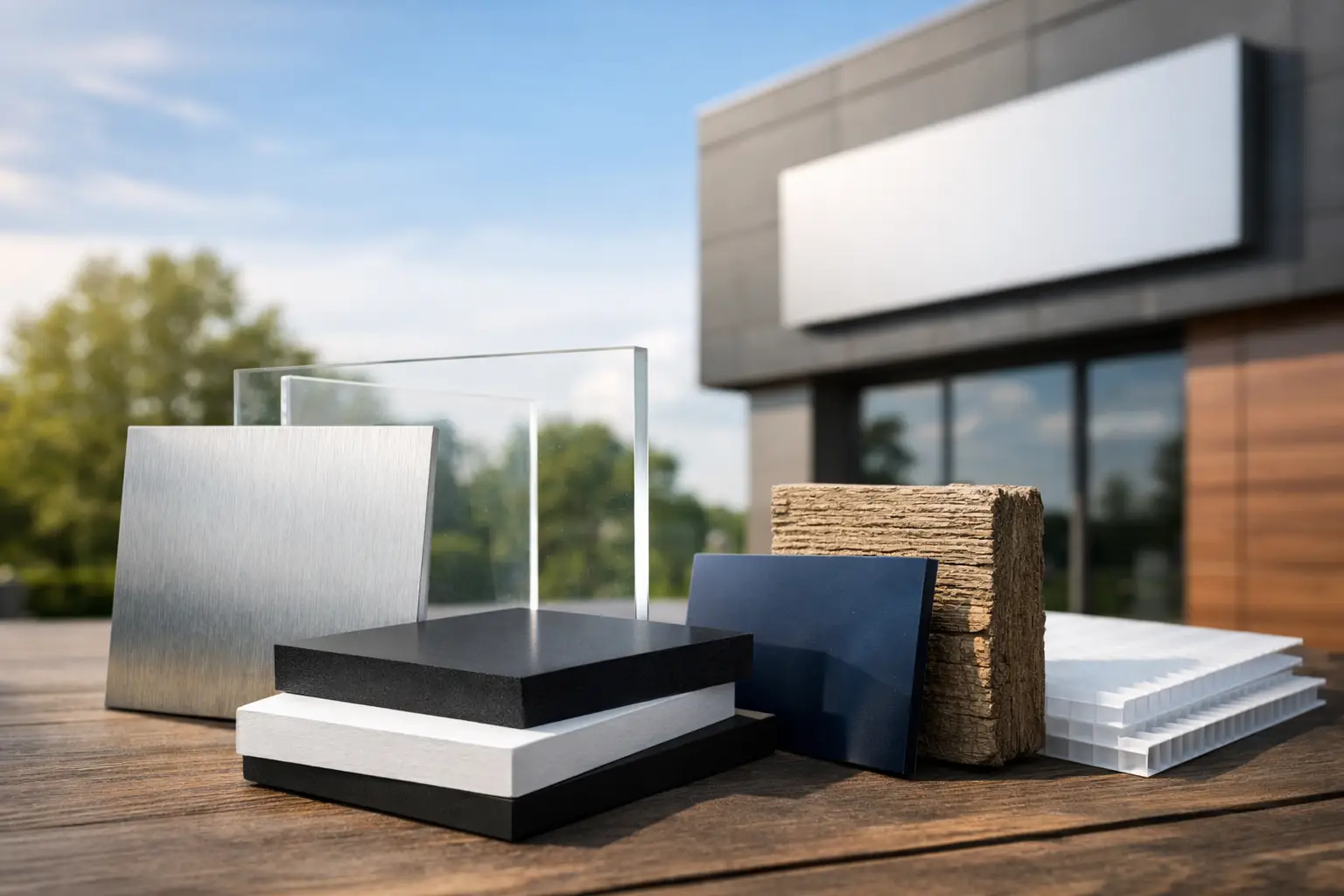
A sign can have excellent artwork and still fail at the material-selection stage. The wrong sign materials may fade too quickly, show warping, limit the depth of routed detail, or create attachment problems once the piece reaches the jobsite. For exterior signs, material is not a background decision. It affects the sign’s profile, finish, service life, shipping method, mounting preparation, and long-distance readability.
The right choice begins with the sign’s job. A carved church entrance sign, a set of building letters, a monument replacement face, and a small interior logo panel may all carry the same brand identity, but they do not need the same material construction. A clear fabrication scope should account for location, viewing distance, desired depth, surface texture, paint finish, attachment method, and who is responsible for installation.
What Sign Materials Need to Do Outdoors
Exterior signage must hold its shape and appearance through heat, rain, sun, temperature shifts, and normal handling. It must also support a design that remains readable from the intended viewing distance. Those requirements often work together, but not always.
For example, very fine engraved copy can look sharp in a proof yet become difficult to read from a roadway. A thin panel may reduce weight and cost, but it may not provide enough depth for a substantial carved border or raised lettering. A reflective metal finish may suit a contemporary building sign, while a textured painted face is more appropriate for a neighborhood monument sign.
Before choosing a material, define the sign’s physical requirements: overall width and height, finished thickness, whether it will be mounted flat or freestanding, the face profile, expected exposure, and the installer’s attachment plan. The customer or installer must verify field measurements, wall conditions, structural capacity, and local permit requirements. A manufacturer can fabricate to approved specifications, but cannot confirm conditions that are only visible at the site.
HDU Sign Materials for Carved and Dimensional Work
For many non-illuminated exterior projects, 15-pound sign-grade high-density urethane is a practical starting point. HDU is a closed-cell urethane material made for sign fabrication. It routes cleanly, does not absorb moisture like wood, and can be used to produce carved backgrounds, recessed copy, raised lettering, dimensional logos, decorative borders, and custom edge profiles.
Its main advantage is stability. Natural wood can bring grain variation, checking, swelling, and movement that complicate a detailed painted sign. HDU does not have a wood grain to fight, which gives CNC routing and finishing work a more consistent base. That consistency is particularly useful when a project calls for crisp routed letters, repeated panels, or a defined recess depth.
HDU is not a universal substitute for every sign material. It is lighter than many solid substrates, but large panels still require proper handling, appropriate support, and an attachment method suited to the finished sign. It also needs a correctly specified coating system and careful finishing to achieve the intended appearance. If a project requires a bare metallic surface, a highly polished appearance, or very thin standalone letters, another material or a layered construction may be a better fit.
For carved entrance signs and dimensional panels, the specification should state more than material thickness. It should identify the desired background texture, recessed areas, raised elements, border layout, paint colors, and any clearances needed around the perimeter. These decisions affect routing time, finish work, and the final visual hierarchy.
Texture, depth, and readability
Depth is useful when it supports the message. A recessed background can make raised letters more visible, especially when the face colors have adequate contrast. A layered logo can add visual interest without making the sign overly busy. But deeper routing is not automatically better. Small copy needs enough stroke width and open space to remain legible after routing and finishing.
A good sign design establishes a clear order: organization name first, property or location information second, and supporting details last. When every line is treated as equally important, the sign usually becomes harder to read. Material and fabrication should reinforce that hierarchy, not compensate for an overcrowded layout.
When Acrylic, PVC, and Metal-Faced Elements Fit Better
Many projects use more than one material. Layering can create contrast, depth, and a finish that would be difficult to achieve with a single substrate. The appropriate combination depends on the design and site conditions.
Acrylic is often selected for clean, precise dimensional letters and logo components. Its smooth face and available colors make it useful when a modern, uniform appearance is required. Acrylic can be effective for wall-mounted lettering, especially where the design calls for crisp edges and a controlled thickness. It is less suited to deeply carved, woodgrain-style sign faces because its character is fundamentally smooth and contemporary.
PVC is a lightweight, routable option commonly used for dimensional letters, painted components, and certain panel applications. It can provide economical thickness and clean painted edges. As with any material, thickness, letter size, exposure, and mounting method matter. Very small or thin elements may require different handling than larger, well-supported components.
Metal-faced components add a different visual language. They can provide a sleek face, a metallic accent, or a more architectural finish when paired with a stable substrate. The trade-off is that metal surfaces show specific handling and finishing characteristics, and the project must account for how the finished component will be attached. Metal is not automatically more durable in every application. The durability of the complete sign depends on fabrication details, coatings, edge treatment, mounting, and exposure.
Specify the Sign Before It Reaches Production
Custom sign work moves more efficiently when the project is defined before routing begins. A written scope reduces avoidable revisions and gives the fabricator a clear standard for inspection. For sign materials, the useful specifications are practical rather than vague.
Provide the final overall dimensions and identify whether they refer to the panel, the complete assembly, or the outside edges of dimensional letters. State the thickness or desired depth, including raised layers and routed recesses. Identify paint colors by recognized color code when available, rather than relying only on a screen image or a verbal color name.
Artwork should be production-ready. Vector files are preferred because they preserve clean paths for routing and scaling. Fonts should be outlined or converted to curves so the letterforms do not change when the file is opened on another system. If a logo includes thin lines, tight interior spaces, or gradients, review whether those details will translate successfully to the selected fabrication method.
For mounted letters and components, clarify the attachment approach early. The fabrication scope may include stud locations, a mounting pattern, or parts prepared for a stated method. It does not automatically include wall drilling, structural blocking, electrical work, permits, lifting equipment, or on-site installation. Those responsibilities need to be assigned clearly, particularly for large exterior signs.
Match the Material to the Viewing Distance
Material selection and sign visibility are connected. A property sign viewed from a passing vehicle needs larger copy, stronger contrast, and a simpler message than a lobby logo viewed from several feet away. A routed texture that looks excellent up close may disappear at distance, while a strong raised-letter shadow line can improve recognition.
Consider the setting as well. Signs near roads may receive higher UV exposure and dirt accumulation. Signs mounted on masonry, EIFS, wood, or metal cladding each present different attachment conditions. A replacement monument face must match the existing frame opening accurately, including its visible area, edge engagement, and any mounting hardware requirements.
This is where exact measurements matter. Measure the actual opening, not only a previous drawing. Confirm whether the frame covers any edge of the panel. Record obstructions, uneven surfaces, and clearances around posts, caps, or landscaping. A well-made replacement face cannot correct an unverified field dimension.
A Better Standard for Custom Sign Fabrication
The best material is the one that supports the approved design, survives its environment, and can be fabricated and installed within a defined scope. That may mean 15-pound sign-grade HDU for a carved entrance panel, acrylic for clean dimensional lettering, PVC for painted components, or a layered assembly that uses each material where it performs best.
At HDU Signs, the process is built around approved artwork, defined material selections, precise CNC routing, finish work, inspection, and protective packaging for shipment. That discipline helps prevent the common gap between what a sign looked like on screen and what arrives ready for installation.
When comparing sign materials, ask for more than a general description or a low number. Ask what the finished thickness will be, how details will be routed, what finish is included, how parts will be prepared for mounting, and what is excluded from the fabrication scope. Clear answers at that stage give the finished sign a better chance to look right, fit right, and continue representing the property well after installation.