Top HOA Entrance Materials for Lasting Signs
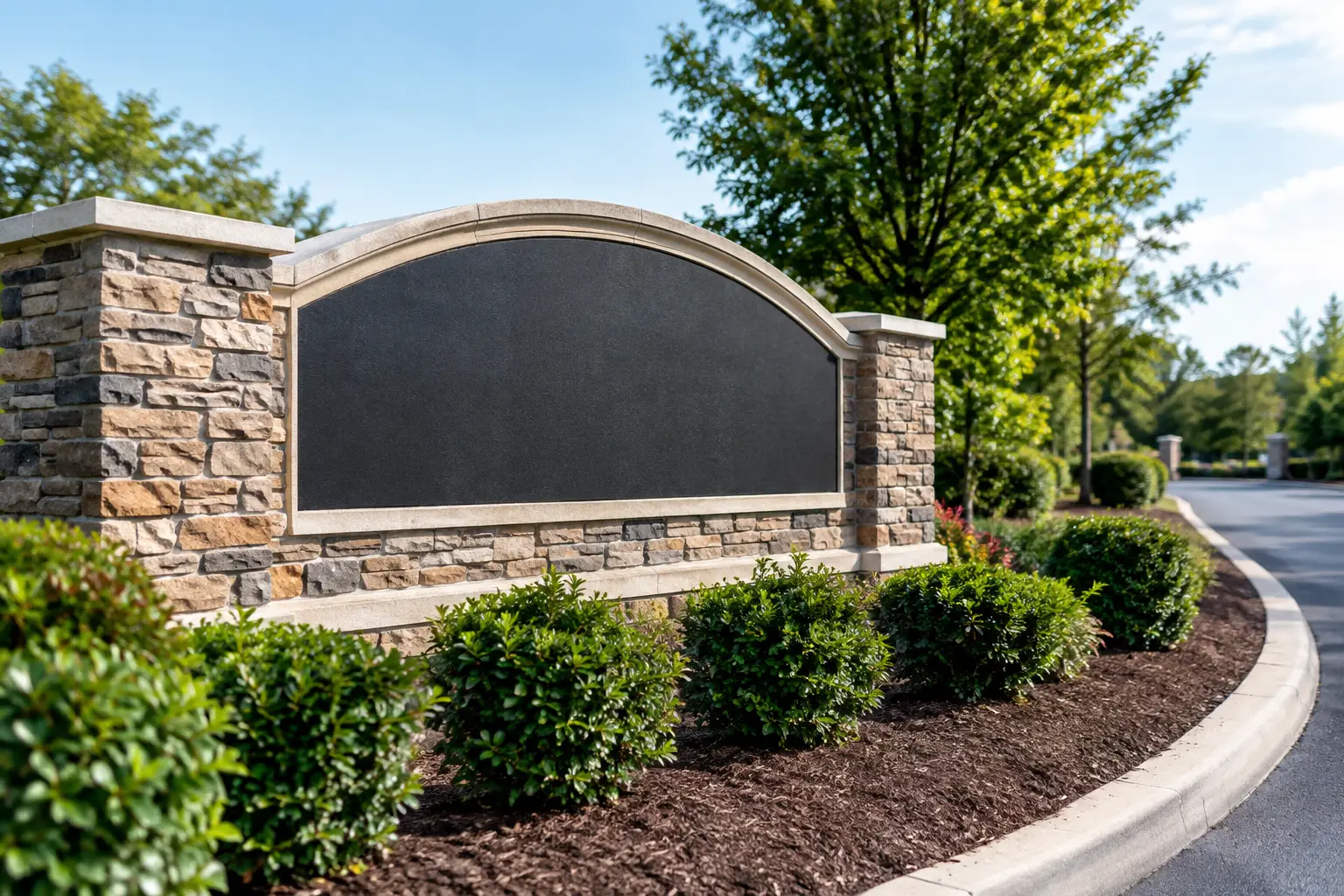
A neighborhood entrance sign has to do more than display a subdivision name. It must remain readable from the road, suit the property’s architecture, tolerate years of sun and rain, and provide a finish the association can maintain without repeated replacement. The top HOA entrance materials are not interchangeable. Each has a place depending on the sign’s scale, design, exposure, and the level of dimensional detail required.
For most associations, the best material decision begins with the finished sign design rather than a request for a generic sign panel. A flat, printed-looking layout calls for different construction than a carved monument face with raised letters, a simulated stone texture, or a layered community logo. Material selection should support the visual goal and the practical conditions at the entrance.
What an HOA Entrance Sign Must Handle
Entrance signage operates in a demanding environment. It faces direct UV exposure, wind-driven rain, irrigation overspray, lawn equipment, road dust, and seasonal temperature changes. At the same time, it often identifies a property from a moving vehicle, where small lettering and low-contrast colors fail quickly.
The structural base, masonry, posts, lighting, and permits are separate considerations from the fabricated sign face. Before a sign is produced, the customer or installer should verify the monument opening, overall dimensions, mounting surface, attachment method, and any local sign requirements. A precisely fabricated panel cannot correct an opening that is out of square or an installation surface that is uneven.
A useful material specification also addresses thickness, edge treatment, painted color, letter depth, border width, and mounting preparation. These decisions affect both appearance and fit.
Top HOA Entrance Materials Compared
Sign-Grade HDU for Carved and Dimensional Designs
Fifteen-pound sign-grade high-density urethane, commonly called HDU, is often the strongest choice for a custom HOA entrance sign with routed detail. Unlike natural wood, HDU does not absorb moisture, rot, split, or develop grain-related movement. It can be CNC routed to create carved backgrounds, raised lettering, recessed copy, custom borders, texture fields, and shaped profiles.
This makes HDU particularly well suited to neighborhood monument signs where the entrance needs more depth than a flat panel can provide. A sandblasted cedar appearance, carved stone-style texture, or dimensional community seal can be created without relying on a natural wood substrate that may require greater maintenance over time.
HDU is also useful when the sign needs substantial visual depth. A routed panel may include a recessed field, raised copy, and a layered logo component, allowing shadows and contrast to improve readability. The trade-off is that deeply routed work, multiple paint colors, and complex profiles add fabrication time and require clear approved artwork. HDU is durable, but it is not a structural framing material. It must be mounted to a properly designed and stable sign structure.
Aluminum for Flat Panels and Replacement Faces
Aluminum is a practical option for flat HOA panels, especially where a sign needs a thin profile, a simple painted surface, or a replacement face for an existing monument cabinet. It is corrosion-resistant and well suited to exterior applications when properly finished.
For a straightforward community identification panel, aluminum can provide a clean and economical result. It is often the right answer when the existing structure already establishes the visual presence and the new face only needs crisp lettering and a durable background.
Its limitation is dimensional expression. Aluminum can be cut and finished in many ways, but a flat sheet does not create the carved texture or thick raised features associated with a traditional dimensional entrance sign. If the board wants depth, aluminum can work as a metal-faced element combined with routed HDU, acrylic letters, or other fabricated components.
Acrylic for Raised Letters and Logo Elements
Acrylic is commonly used for dimensional lettering, address numbers, and logo pieces. It provides a smooth, precise face and is available in a range of colors, thicknesses, and finish approaches. For HOA monuments, acrylic is often used as a secondary material rather than the entire sign face.
Raised acrylic letters can improve contrast on a routed HDU panel or a painted background. The crisp edges work especially well for contemporary properties, apartment-style communities, mixed-use developments, and entrances with a clean architectural style.
Acrylic should be specified with its viewing conditions in mind. Very thin letters can lose presence at road distance, while glossy surfaces may produce glare in direct sun. Letter height, color contrast, stroke width, and mounting method matter as much as the material itself. For exterior dimensional lettering, the approved layout should show each component’s size and placement before production begins.
PVC for Simple Routed Panels
PVC sheet can be routed into letters, panels, and basic dimensional components. It is a useful material for projects that need a smooth painted finish and modest depth without the carving capabilities or thicker sculpted look of HDU.
For an HOA sign, PVC may make sense for a protected location, a smaller identification panel, or a simple layered design. It is not always the preferred choice for a large, highly detailed monument sign exposed to long-term weather and heavy sun. The appropriate thickness and sign design depend on the panel size, attachment plan, and site exposure.
PVC is best evaluated as part of a complete assembly. A well-designed panel with proper support can perform differently from a large unsupported sheet or a thin routed letter set installed on an uneven surface.
Metal-Faced Components for Architectural Finishes
Metal-faced elements can bring a more architectural appearance to an entrance sign. Brushed aluminum, painted metal, or other metal-faced components may be used for accents, logos, lettering, or panel faces where the property’s architecture calls for a sharper, more contemporary finish.
These materials work well with brick, stone, stucco, and modern masonry monuments. They can also create a strong contrast against textured HDU backgrounds. The main consideration is finish selection. A subtle brushed finish may be more readable than a highly reflective surface, particularly at entrances facing afternoon sun or vehicle headlights.
Choose Materials Around Visibility, Not Just Appearance
A material that looks attractive at arm’s length may underperform from the street. HOA boards should consider the speed of approaching traffic, setback from the roadway, sign height, and the visual clutter surrounding the monument. A community name viewed from 75 feet needs different letter proportions than one viewed from a driveway.
Contrast is usually more valuable than decorative complexity. Light letters on a dark field, or dark letters on a light field, are generally easier to read than closely matched colors. Thick, clean letterforms also hold up better at distance than delicate scripts or tightly spaced copy.
Dimensional construction can assist visibility when used with restraint. Raised letters and recessed backgrounds create natural shadow lines, but shadows are not a substitute for adequate letter size or color contrast. A routed sign should still be legible under overcast conditions and after the finish has experienced normal outdoor wear.
Match the Material to the Entrance Architecture
Traditional subdivisions often use HDU with carved textures, raised serif lettering, decorative borders, and painted finishes that complement brick or stone. This approach delivers the established look many associations want while avoiding the maintenance concerns of real carved wood.
Contemporary communities may favor a flatter aluminum panel, metal-faced logo, or clean acrylic lettering on a simple background. A layered HDU panel can also work in a modern setting when the design uses restrained depth, square corners, and a limited color palette.
The most successful HOA signs do not imitate every finish on the property. Instead, they select one or two architectural cues and build a readable sign around them. Stone columns, for example, may support a carved HDU face with a stone-textured field, while a stucco monument may benefit from smooth dimensional letters and a crisp border.
Production Details That Prevent Costly Problems
Custom entrance signs should be quoted and fabricated from approved production information, not from a low-resolution image or a rough visual reference alone. Vector files are preferred for logos and lettering. Fonts should be outlined, and artwork should identify final dimensions, colors, recess depth, raised elements, and any separate mounted components.
The written scope should also establish what is being manufactured. It may include a routed HDU panel, painted dimensional letters, metal-faced logo components, or a replacement monument face. It should not assume that posts, masonry work, electrical service, permits, or installation are included unless specifically stated.
Before fabrication, the customer or installer must verify field measurements and mounting conditions. This is particularly important for replacement faces, where a small discrepancy in opening size, fastener location, or trim clearance can affect installation. Clear responsibility at this stage protects the finished work and avoids preventable site delays.
Specify for the Sign You Want to Maintain
The right HOA entrance material is the one that fits the property, supports the planned design, and can be maintained realistically by the association. HDU offers exceptional flexibility for durable carved and dimensional work. Aluminum and metal-faced components suit clean architectural panels. Acrylic and PVC can provide effective dimensional elements when selected for the correct scale and exposure.
A well-specified sign gives the installer a clear fit, gives residents a recognizable entrance, and gives the board a finished asset that continues to represent the community with confidence long after the monument is complete.