What Is Sign Grade HDU? Key Material Facts
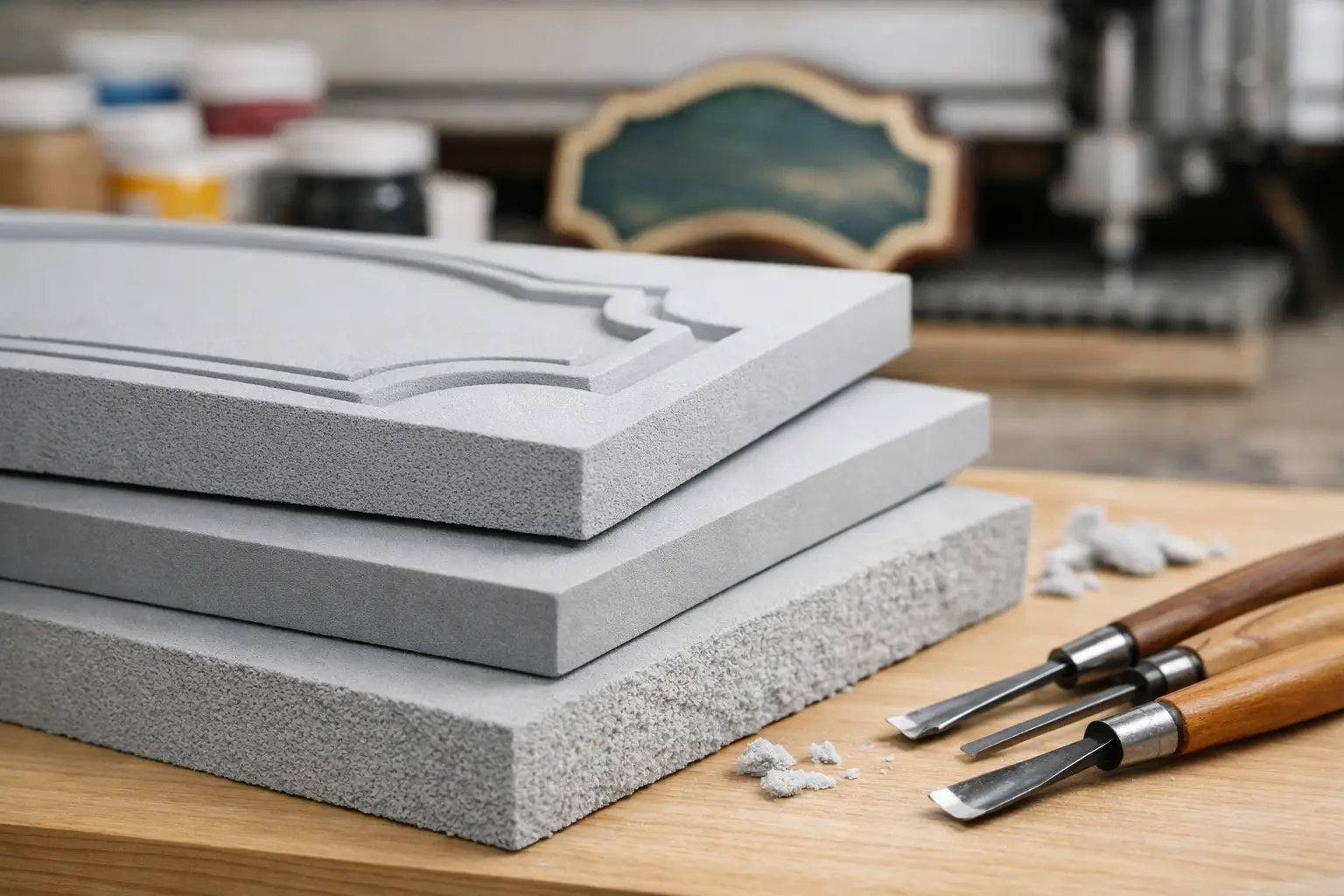
A routed entrance sign has to do more than look good when it leaves the shop. It must remain readable from the road, hold its finish through changing weather, and preserve the intended details over time. That is why buyers often ask, what is sign grade HDU, and whether it is the right material for an exterior sign project.
Sign-grade HDU is high-density urethane manufactured in rigid sheets for carving, routing, shaping, and finishing. In sign fabrication, 15-pound HDU is a common choice because it provides a reliable balance of detail retention, exterior durability, weight, and workability. It can be CNC routed into dimensional lettering, recessed backgrounds, woodgrain textures, borders, logos, and custom panel profiles without the knots, grain movement, and moisture-related instability of natural wood.
What Is Sign Grade HDU Made For?
HDU is a closed-cell polyurethane material. Unlike wood, it does not absorb water in the same way, and it will not rot, split, or develop grain checks from ordinary exterior exposure. Unlike foam board intended for insulation or crafts, sign-grade HDU is specifically manufactured with a density and surface quality suitable for precision fabrication and durable paint systems.
The “15-pound” designation refers to density: approximately 15 pounds per cubic foot. Higher density gives the material a firmer surface and better support for machined details. For many routed signs, it is a practical density because it accepts sharp carving, performs well under exterior coatings, and remains far lighter than a comparable solid wood panel.
That lighter weight matters on large entrance signs, wall panels, and replacement monument faces. It can reduce handling difficulty and simplify certain mounting approaches. It does not eliminate the need for proper structure, however. The customer, contractor, or installer must determine mounting conditions, attachment methods, wind exposure, and code requirements for the specific site.
Sign-Grade HDU Is Not a Generic Substitute for Every Material
HDU is highly versatile, but it is not the automatic answer for every sign application. It is not a structural post material, and it should not be expected to carry loads beyond the engineered support system behind it. A large freestanding sign still requires appropriate posts, steel, masonry, or another verified structural framework.
It also has a different visual character from metal, acrylic, and real wood. A well-finished HDU panel can convincingly reproduce carved wood textures or create a clean, contemporary routed face. But if a project calls for a brushed metal surface, translucent illumination, or a very thin high-gloss letter face, another material or a mixed-material construction may be more appropriate.
Why 15-Pound Sign-Grade HDU Works for Exterior Signs
The main value of 15-pound sign-grade HDU is predictability. A sign manufacturer can machine it consistently, create controlled recess depths, and build raised elements without needing to work around random grain direction or natural defects. That control is especially useful when a sign includes a detailed logo, a custom border, or lettering that must be clean and readable at a distance.
A typical routed HDU sign may include a recessed field with raised copy and a raised logo. The background can receive a carved texture, while the raised elements are finished in contrasting colors for legibility. Layered HDU components can add more depth, and acrylic, PVC, or metal-faced pieces may be incorporated where a different finish or sharper visual contrast is needed.
HDU also gives designers latitude with shape. Instead of limiting a sign to a plain rectangle, the panel can be routed with arched tops, curved profiles, decorative corners, dimensional frames, or custom silhouettes. These details should support the sign’s purpose, not compete with it. For a roadside monument sign, overall letter size, contrast, and viewing distance usually matter more than elaborate carving.
Durability Depends on Fabrication and Finish
HDU itself resists the problems commonly associated with exposed wood, but material selection is only one part of exterior performance. Routed edges must be prepared correctly. Seams, attachment locations, and transitions between materials need to be planned. The coating system must be appropriate for exterior use and applied with attention to coverage and finish consistency.
A durable sign is not simply a sheet of HDU with paint on it. It is a fabricated component with defined thickness, routed depth, finish colors, mounting preparation, and protective packaging for shipment. When those details are left vague, the finished result becomes difficult to evaluate and even harder to reproduce later.
Common Applications for Sign-Grade HDU
Sign-grade HDU is often specified for carved and dimensional signs where a substantial, custom-built appearance is needed without the maintenance concerns of natural wood. It is well suited to business entrance signs, church signs, neighborhood and HOA identification signs, property markers, office park signage, golf course signs, and directional panels.
It is also useful for replacement monument faces. When an existing monument structure is sound but the sign face is damaged, outdated, or no longer reflects the organization’s branding, a custom HDU replacement panel can be manufactured to the required dimensions and attachment layout. Accurate field measurements are essential. The customer or installer must verify overall dimensions, existing clearances, mounting locations, and site conditions before fabrication begins.
For wall-mounted branding, routed HDU can serve as a shaped panel behind dimensional letters or as the primary sign face itself. Depending on the design, separate raised letters may be fabricated from HDU, acrylic, PVC, or metal-faced materials. The right combination depends on desired depth, finish, budget, and the building surface where the sign will be installed.
Design Details That Affect the Finished Sign
A strong HDU sign begins with artwork that can be manufactured accurately. Vector artwork is preferred because it defines letters, logos, borders, and shapes as clean paths rather than pixels. Fonts should be outlined before production so the letterforms do not change because of missing font files or software substitutions.
The artwork should also communicate production details, not just appearance. That includes overall width and height, panel thickness, recess depth, raised copy height, border width, colors, and any separate components. If a specific brand color is required, identify it using an agreed color reference rather than relying on how a color appears on an uncalibrated screen.
Legibility needs equal attention. Fine serif lettering, shallow contrast, and tightly packed lines can look attractive on a computer monitor while becoming difficult to read from a vehicle. A sign intended for a driveway entrance has different visibility requirements than a building plaque viewed from a few feet away. Design decisions should reflect the actual viewing distance, speed of traffic, and available lighting.
Thickness, Depth, and Scale Are Connected
HDU is available in different thicknesses, and thickness should be selected based on the sign’s size, profile, required recess depth, and mounting plan. A small wall panel may not need the same thickness as a large freestanding monument face. Similarly, a deep carved texture requires enough material behind it to maintain a sound panel.
Raised elements need practical edge clearance. Letters or borders placed too close to the outside edge can complicate routing, finishing, and handling. Small interior details may also need to be simplified if they cannot be routed cleanly or if they will not remain visually meaningful at the finished sign’s intended scale.
HDU Compared With Wood, PVC, Acrylic, and Metal
Natural wood offers authentic grain and a familiar traditional appearance, but it requires careful selection, sealing, finishing, and maintenance. Wood can move with moisture and temperature changes, and natural grain may influence the crispness of routed details. HDU is often chosen when the desired look is carved and substantial but the project benefits from a more stable substrate.
PVC can be useful for flat dimensional letters and certain layered components. It is often a practical option when a carved texture is not required. Acrylic provides clean edges and is commonly used for polished dimensional lettering or colored logo elements. Metal-faced materials can provide a finish that HDU alone cannot replicate, such as brushed aluminum or a metallic laminate appearance.
There is no universal best material. The correct choice depends on whether the sign needs deep carving, a woodgrain texture, a lightweight panel, a glossy letter face, a metallic finish, or a particular mounting configuration. A written scope should identify the exact material and construction rather than using broad terms such as “dimensional sign” without further definition.
What to Confirm Before Ordering an HDU Sign
Before fabrication, confirm the approved artwork, final dimensions, thickness, colors, routed features, and attachment preparation. If the panel will fit into an existing monument cabinet or frame, verify the opening size in multiple locations rather than assuming it is perfectly square. Confirm whether hardware, stud locations, or mounting holes are included in the manufacturing scope.
It is also wise to decide who is responsible for each phase. A custom sign manufacturer can quote, fabricate, inspect, package, and ship the finished sign components. Permits, structural engineering, electrical work, site preparation, and installation are separate responsibilities unless expressly included. Clear boundaries protect the project from assumptions that can cause delays at the jobsite.
The best HDU sign projects are defined before the router starts: readable artwork, verified measurements, realistic finish expectations, and a mounting plan that matches the site. When those decisions are handled early, sign-grade HDU becomes what it is meant to be - a dependable material for creating exterior signage with real dimension, controlled detail, and a finish built to represent the property well.