When to Replace Monument Sign Panels
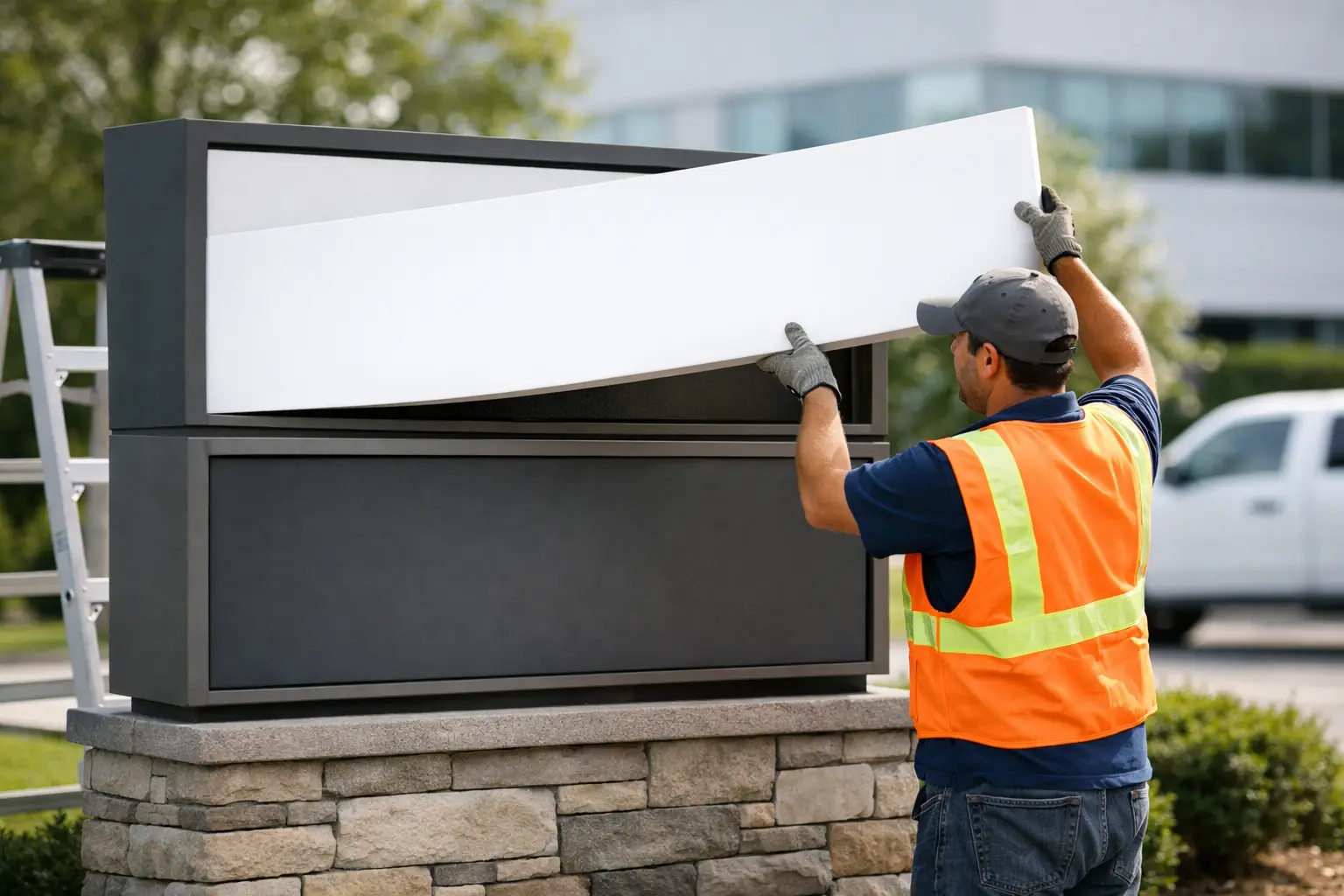
A monument sign can remain structurally sound while its face panel stops doing its job. Knowing when to replace monument panels is less about a fixed age and more about whether the sign still identifies the property clearly, fits its structure correctly, and presents the organization at the standard visitors expect.
For a business entrance, church campus, subdivision, office park, or commercial property, a faded or damaged monument panel is not a minor cosmetic issue. It can make the property harder to find, reduce curb appeal, and create the impression that maintenance has been deferred. The right replacement decision starts with a close look at the panel, the frame or monument body around it, and the conditions that caused the original face to fail.
When to Replace Monument Panels Instead of Repairing Them
Replacement is usually the practical choice when the panel has broad surface failure, significant warping, deep cracks, outdated graphics, or damage that affects readability. Small scratches or isolated paint chips may be repairable in place. But field repairs can be difficult to blend, especially on textured backgrounds, routed surfaces, multi-color layouts, or panels that have faded unevenly over time.
A panel should also be replaced when its message has changed. A property name, tenant lineup, address, logo, or directional designation may no longer be current. Applying temporary vinyl patches over an old routed or painted face can create a short-term solution, but it rarely delivers the clean appearance of a properly designed replacement panel.
The panel’s condition is only one part of the decision. If the monument structure is sound, replacing the face can be a targeted way to renew the sign without rebuilding masonry, brick, stone, stucco, or the supporting framework. If the structure itself is loose, water-damaged, cracked, or out of plumb, the customer or installer should address those site conditions before ordering a new panel.
Visible Signs a Monument Panel Has Reached Its Service Limit
Exterior signs face UV exposure, heat cycles, rain, wind-driven debris, irrigation overspray, lawn equipment, and occasional impact. Different materials fail in different ways, but the following conditions usually justify a closer evaluation.
Fading That Reduces Contrast
Color fading matters most when it reduces the contrast between the background and the lettering. A pale background behind light letters, or dark letters that have shifted toward gray, can make a sign difficult to read from the street. This is especially noticeable on monument signs that serve drivers moving at speed rather than pedestrians standing nearby.
A replacement panel provides an opportunity to correct the issue, not simply repeat it. The new design can use more effective color separation, larger copy, cleaner borders, and a layout scaled for the actual viewing distance.
Cracking, Splitting, or Delamination
Cracks at fastener locations, edges, routed areas, or around cutouts may indicate that a panel has reached the end of its useful life. Delamination can occur when layered materials separate due to moisture intrusion, thermal movement, or material breakdown. Once water enters a panel assembly, surface repairs often do not solve the underlying problem.
The replacement material should be selected based on the panel’s exposure, required thickness, attachment method, and visual design. For carved, dimensional, or textured monument faces, 15-pound sign-grade HDU offers a stable, routable substrate that does not absorb water or develop the grain movement associated with natural wood.
Warping or Poor Fit Within the Frame
A panel that bows outward, pulls away from its mounting surface, or no longer sits evenly within a retaining frame should not be ignored. It may be under stress from moisture, an incompatible material, overly tight installation, inadequate support, or changed site conditions.
Before fabrication begins, the customer or installer must verify the opening dimensions, panel thickness, mounting method, and available clearance. A replacement panel cannot correct a distorted frame by itself. Accurate measurements are essential because monument openings are not always perfectly square, even when they appear to be from a distance.
Dated Branding or Illegible Information
A monument sign often remains in place for decades, while the organization using it changes names, logos, color standards, or tenant information. When the panel no longer reflects the current identity, replacement is generally more effective than modifying the old face.
This is also the time to reconsider copy density. Long lists, small tenant names, thin typefaces, and low-contrast graphics can look acceptable in a proof but fail at real viewing distance. A revised panel should prioritize the information people need first: property name, organization name, address, suite or tenant information, and directional content where applicable.
Evaluate the Monument Before Ordering a New Face
A well-made replacement panel depends on reliable field information. Manufacturing begins with the component being produced, while site verification and installation remain the responsibility of the customer or installer unless specifically included in the written scope.
Start by documenting the existing sign from several angles. Measure the visible panel opening, the overall panel size if accessible, the depth of any recess, and the available thickness behind the face. Note whether the panel is surface-mounted, installed in a cabinet-style frame, captured by trim, bolted through from the front, or attached from the rear.
Photographs should show the full monument, close-ups of the panel edges, mounting hardware, and any damage. These details help identify whether the new panel needs square corners, radius corners, routed relief, border clearance, drilled holes, or a specific profile to work with the existing structure.
If the existing panel is being used as a pattern, do not assume it was made to the correct dimensions. Measure the actual opening and confirm how much clearance is needed for installation. A panel built too tightly may be difficult to install. One built too small can leave uneven gaps that collect debris and distract from the finished appearance.
Specify the Replacement Panel for Exterior Performance
The best replacement is not always an exact material-for-material duplicate. The appropriate construction depends on the desired appearance and the conditions at the site.
HDU is well suited to custom routed panels with carved backgrounds, raised letters, dimensional logos, sandblasted-style textures, and painted finishes. It can be fabricated in substantial thicknesses to create visual depth without the instability of wood. Acrylic, PVC, and metal-faced elements may also be appropriate when the design calls for a smooth finish, layered contrast, metallic appearance, or specific dimensional components.
The artwork should define the finished panel, not merely the logo. Vector files are preferred, and fonts should be outlined before production. Provide the intended overall dimensions, background color, copy color, logo colors, and any required Pantone, paint, or other color references. If the panel includes raised lettering or routed details, the artwork and scope should identify those features clearly.
For a replacement face that must align with existing hardware, specify drilled holes only after field dimensions have been verified. Hole locations based on an old drawing or an assumed centerline can create expensive installation problems. The same caution applies to trim overlap and recessed-panel depth.
Replacement Timing Depends on Risk, Not Just Appearance
Some panel failures are primarily visual. Others create a practical risk. A loose panel, sharp broken edge, exposed fastener, or face that may detach in high wind should be addressed promptly by a qualified installer. Manufacturing a replacement component and correcting the site installation are separate parts of the project, and both need to be planned.
For less urgent deterioration, replacement can be scheduled around rebranding, seasonal property improvements, tenant turnover, or planned maintenance. Ordering before the old face becomes unreadable gives the project team time to approve artwork, verify measurements, select finishes, and coordinate installation without relying on a rushed field solution.
A clear written scope helps prevent assumptions. It should identify the finished dimensions, material, thickness, routed or layered features, colors, attachment preparation, and what is included in the shipment. It should also make clear what is not included, such as permits, structural repair, removal of the existing face, or installation at the site.
A Better Replacement Starts With What the Sign Must Do
The most successful monument panel replacement is not simply a new version of an old sign. It is a component built to fit the existing monument, withstand exterior exposure, and communicate at the distance where people actually see it.
Before approving production, stand at the roadway or entry point and ask a practical question: can a first-time visitor read the essential information quickly? If the answer is no, the replacement panel is the right moment to correct the design as well as the material condition.