Why Sign Colors Fade and How to Specify Better
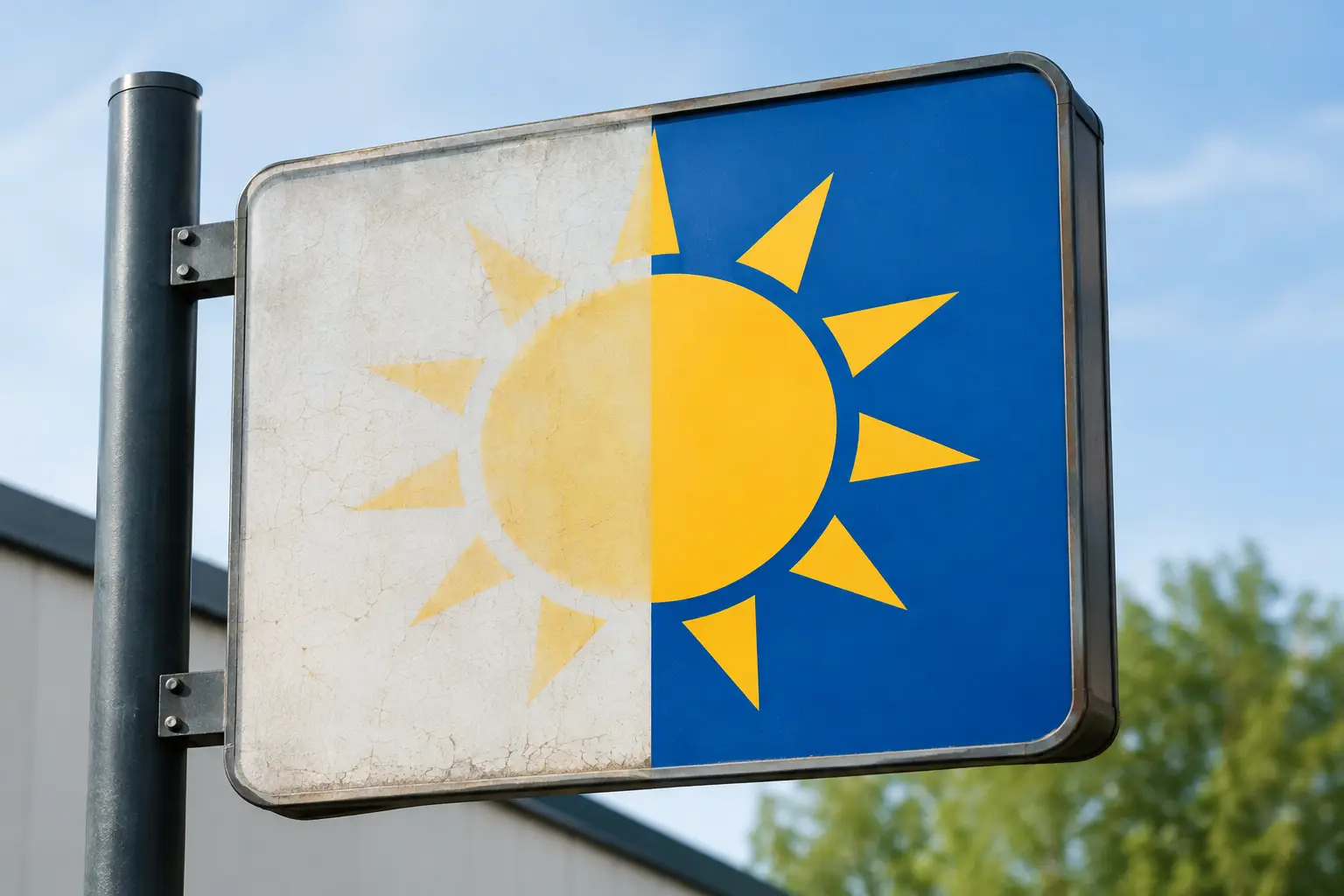
A sign can leave the shop with crisp color contrast and still look tired years earlier than expected. When sign colors fade, the cause is rarely one bad decision. It is usually the combined effect of sun exposure, heat, moisture, pigment selection, coating quality, cleaning practices, and the sign’s orientation on the property.
For a business entrance, church campus, monument sign, or commercial building letter package, color retention is not merely cosmetic. Fading can reduce contrast, weaken readability at distance, and make an otherwise sound sign look neglected. The right specification does not guarantee that exterior colors will never change, but it can substantially improve how the sign performs over its service life.
Why Sign Colors Fade Outdoors
Ultraviolet radiation is the primary source of exterior color loss. UV energy breaks down the chemical bonds in many colorants and binders over time. Bright sunlight accelerates that process, particularly on south- and west-facing signs that receive prolonged afternoon exposure.
Heat compounds the issue. A dark-colored panel, metal face, or dimensional letter can become much hotter than the surrounding air. Repeated heating and cooling places stress on paint films, adhesives, clear coats, and some applied graphics. In humid climates, moisture can enter small imperfections in coatings or seams, which may lead to chalking, staining, edge failure, or peeling depending on the material system.
Georgia and other Southern markets present a demanding combination of strong sunlight, heat, rain, humidity, pollen, and biological growth. Coastal locations add salt exposure. Northern sites may have less annual UV intensity but introduce snow, freeze-thaw cycles, and deicing chemicals. A color specification that performs adequately in a covered storefront application may not be appropriate for an exposed freestanding entrance sign.
Fading, Chalking, and Color Shift Are Different Problems
Customers often use “fading” to describe several types of finish change. True fading is a loss of color intensity. A red may become pink, a dark blue may become grayish, or a black may appear less deep.
Chalking is different. It occurs when weathering breaks down the outer surface of a coating and leaves a powdery residue. The sign may look lighter or duller even if some underlying color remains. Color shift occurs when one pigment component degrades faster than another, changing the apparent hue. A green can move toward blue or yellow, for example.
These distinctions matter because the remedy depends on the failure mode. Cleaning may improve a dirty or chalked surface temporarily, while a severely faded coating usually requires refinishing or replacement. A written material and finish scope helps establish what was manufactured and what maintenance expectations apply after installation.
Sign Colors Fade Faster When Contrast Is Poorly Planned
Some colors are inherently more vulnerable outdoors than others. Bright reds, oranges, yellows, and certain purples can be more difficult to retain than neutral tones, depending on the pigment technology and coating system used. This does not mean a property cannot use a bright brand color. It means that color should be selected with realistic expectations and supported by appropriate materials and finishes.
Dark colors create a separate trade-off. Black, deep navy, charcoal, and dark bronze often retain a professional appearance, but they absorb heat. On large, exposed panels, high surface temperature can increase stress on the paint and substrate. Very light colors reflect more heat but can show dirt, runoff marks, and mildew more readily.
Contrast is the practical concern. A slightly faded color can still function well if the sign was designed with strong light-dark separation between its background and lettering. A low-contrast palette may become difficult to read after modest weathering. For exterior identification, legibility should be evaluated from actual viewing distance, not only from a digital proof viewed at close range.
Material Choice Affects Long-Term Appearance
The sign substrate does not create UV resistance by itself, but it affects how well the entire assembly handles exterior stress. Sign-grade 15-pound HDU is a stable, routable material for dimensional exterior signs because it does not absorb moisture and move like natural wood. It can be carved, textured, and finished with raised letters, recessed copy, borders, and layered components.
A stable substrate gives the paint system a better foundation. However, HDU still needs correctly prepared and coated surfaces. Routed edges, deep recesses, and textured areas require attention because those details create more surface area and can collect moisture, dirt, and airborne contaminants.
Acrylic, PVC, and metal-faced elements each serve different design and performance needs. Acrylic can provide clean dimensional color and polished edges in suitable applications. PVC is often useful for painted dimensional components. Metal faces may offer a particular architectural look, but metal expands and contracts with temperature changes and requires appropriate attachment and finishing methods. No single material is automatically best. The proper choice depends on exposure, design depth, mounting conditions, budget, and the desired maintenance cycle.
Paint Is Not the Same as Printed Color
A painted sign, a digitally printed graphic, a colored acrylic element, and a vinyl-applied face can all look similar when new. Their long-term weathering characteristics may be very different.
Printed and vinyl graphics are especially dependent on film quality, ink system, laminate, edge exposure, and installation conditions. They can be appropriate for replacement faces and graphic-heavy applications, but the specification should account for expected outdoor life and possible future replacement.
For routed HDU panels and dimensional letters, professional exterior coating systems are commonly selected for their adhesion, coverage, and weathering characteristics. Exact product selection should match the substrate and finish process. A clear coat may add protection in some applications, but it is not a universal answer. Clear finishes can also age, yellow, scratch, or fail if the underlying system is not compatible.
Specify Color Before Production Begins
“Blue,” “bronze,” or “burgundy” is not a production specification. Color should be identified by a recognized code or a physical sample approved for the project. If a brand standard uses a Pantone reference, the production team still needs to determine how that target will be interpreted in the selected paint, film, acrylic, or coated metal finish.
Digital artwork is useful for layout approval, but monitors, printers, and phone screens do not display color consistently. A vector file is preferred for routed components, and fonts should be outlined before production. The approved artwork should also identify background color, copy color, border color, logo components, finish locations, panel dimensions, recess depth where applicable, and any layered or metal-faced elements.
For multi-tenant properties or institutional campuses, document the color system before ordering the first sign. Future replacement panels, directional signs, building letters, and monument faces are easier to match when the original specification is retained. Even then, an exact match years later may not be possible because the existing sign has weathered.
Site Conditions Should Drive the Finish Decision
A sign under a deep canopy has different demands from one installed at the entrance drive with no shade. Before fabrication, consider the direction the face will point, whether sprinklers will strike it, whether trees drop sap or tannins, and whether irrigation runoff or landscaping equipment will contact the sign.
Sprinklers deserve particular attention. Water with mineral content can leave deposits that make colors appear faded or stained. Constant wetting can also shorten the life of coatings and applied graphics. Locate irrigation heads away from the sign where possible, and make sure drainage does not direct water behind a panel or into unsealed installation points.
Installation details matter as well. The customer or installer must verify field measurements, structural support, mounting surfaces, and attachment locations before installation. A well-fabricated panel can still have premature finish issues if fasteners damage the face, penetrations are not properly sealed, or incompatible sealants stain the material.
Maintenance Can Preserve the Intended Color
Exterior signs benefit from periodic inspection and gentle cleaning. Wash off pollen, dust, road film, bird droppings, and landscape residue before they bake onto the finish. Use a mild cleaner, soft cloth, or soft brush, then rinse thoroughly with clean water. Avoid abrasive pads, harsh solvents, and high-pressure washing at close range, particularly around routed edges, seams, applied graphics, and dimensional letters.
Inspect for early signs of coating wear, cracks, lifting edges, water intrusion, or staining. Addressing a small failure before moisture reaches the substrate or attachment area is usually simpler than waiting for widespread deterioration. Keep records of the original color codes, material selections, approved artwork, and finish details for future maintenance or replacement work.
At HDU Signs, clear production scopes and approved artwork help customers make those decisions before fabrication, when material and finish choices can still be matched to the sign’s real conditions.
A durable exterior sign is not one that never changes. It is one specified so that its color, contrast, and construction continue to represent the property well after the first season of sun and weather.